An important concern for anyone planning retirement is: "Will my retirement savings last throughout my life, or will they run out before I do?"
An annuity, or pension paid in instalments, is an income-protection arrangement intended to provide lifelong financial security for private-sector employees, IT workers and self-employed people who do not have a guaranteed monthly income like that provided to government employees under the former Old Pension Scheme (OPS).
The article also discusses the requirement for subscribers to the National Pension System (NPS) to use a specified portion of their savings to purchase an annuity on retirement at age 60.
An annuity is a legal financial contract between an individual and a life insurance company.
Under the contract, the investor pays the insurer a lump sum known as the purchase price. In return, the company pays a regular, fixed, guaranteed pension monthly, quarterly, half-yearly or annually for the investor's lifetime, or for the period agreed in the contract.
Longevity risk transfer:
The risk that a person's savings may not last if they live longer than expected—for example, to age 85, 95 or 100—is called longevity risk. An annuity transfers this risk to the insurer: under the policy contract, pension payments continue to be credited to your bank account for life, regardless of how long you live.
Bank fixed deposit (FD) vs annuity: what is the difference?
Feature
Bank fixed deposit
Annuity
Interest / income guarantee
The interest rate is guaranteed for a maximum of 5 to 10 years.
The rate remains fixed throughout life, whether for another 30, 40 or 50 years.
Reinvestment risk
Yes. If interest rates have fallen when the FD matures—for example, from 7% to 4%—it can only be renewed at the lower rate.
No. The income rate fixed when the policy is purchased remains unchanged for life.
Access to principal (liquidity)
The principal can be withdrawn at any time subject to a penalty.
Generally, principal cannot be withdrawn early, except in certain medical emergencies.
Life insurers in India offer annuities based on two main payment timelines:
Immediate annuity: Pension payments begin shortly after the lump sum is paid—in the next month, quarter or year. This is a direct option for people retiring at 58 or 60 and for those receiving their NPS maturity proceeds. (Examples: LIC Jeevan Akshay VII, SBI Life Annuity Plus.)
Deferred annuity: Pay a lump sum now or instalments over a specified number of years, then begin receiving the pension at a future age rather than immediately—for example, after 5 or 10 years, at age 55 or 60. (Example: LIC Jeevan Shanti.)
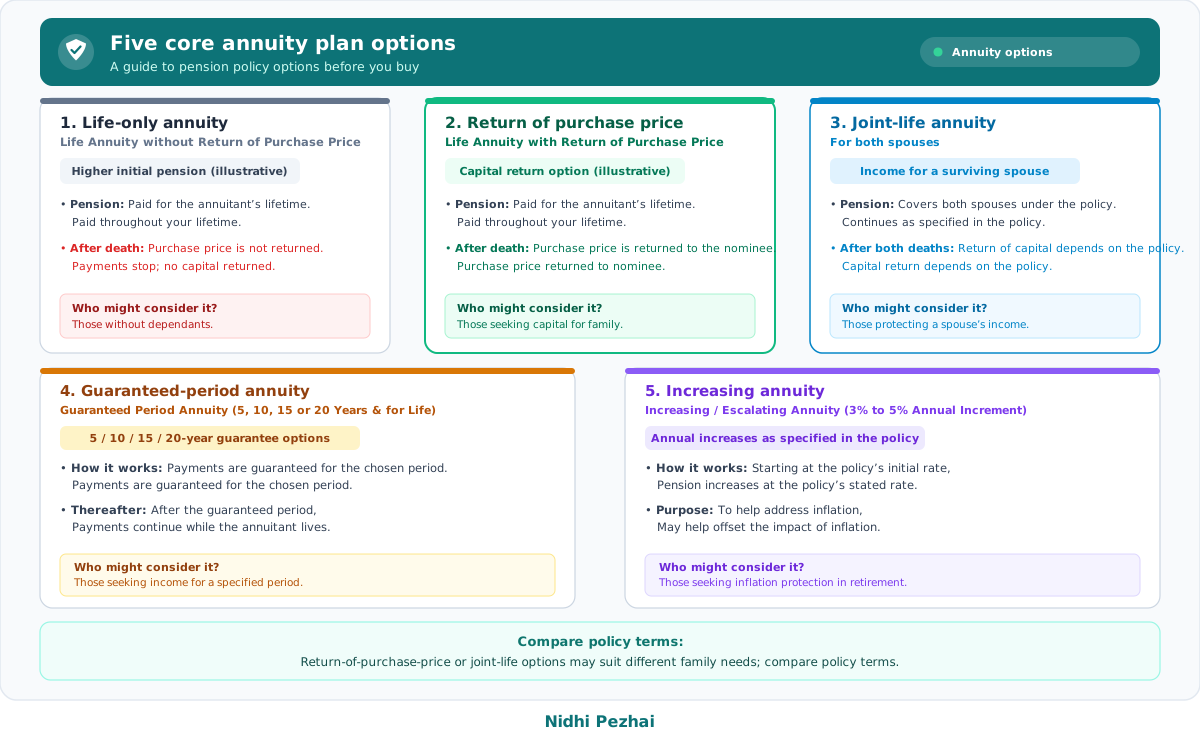
When taking out an annuity, you must choose one of the following five options. Each is described in detail below:
1. Life Annuity without Return of Purchase PriceHighest Pension (~8-9%)
How it works: Pays the highest monthly pension for as long as the investor is alive (for example, a ₹10 lakh purchase price might yield approximately ₹85,000 – ₹90,000 annually).
On death: The pension ceases in the month following the investor's demise; the original capital (Purchase Price) is not returned to heirs.
Who it is suitable for: Retirees with no dependants or those who do not have an obligation to leave an estate to the next generation, seeking strictly the maximum monthly cash flow.
2. Life Annuity with Return of Purchase Price (ROP)Chosen by 80% of Buyers (~6.5%)
How it works: Pension is paid monthly for the entire lifetime of the investor. The payout rate is about 1% to 2% lower than a simple life annuity (for example, around ₹63,000 – ₹68,000 annually for a ₹10 lakh purchase price).
On death: Upon the investor's demise, 100% of the initial capital paid for the policy is returned to the nominee (family) tax-free.
Why it is popular: Because it provides peace of mind that the principal safely returns to the family, this is the primary plan chosen by more than 80% of annuity buyers in India.
3. Joint Life Annuity with Return of Purchase PriceSpousal Protection
How it works: Protects both husband and wife. The investor receives the full pension for life. After their demise, 100% of the pension continues uninterrupted to the surviving spouse for the rest of their lifetime.
After both pass away: Once both spouses have passed away, the full purchase price is returned to the next-generation nominees (children).
Who it is suitable for: Retirees who want to ensure that their spouse's monthly livelihood continues without disruption even in their absence.
4. Annuity Guaranteed for 5, 10, 15 or 20 YearsGuaranteed Period
How it works: Whether the investor is alive or unexpectedly passes away during the selected period (e.g., 15 years), the pension is guaranteed to be paid to the investor or family until the term ends.
If the investor survives beyond the 15-year period, the pension continues for the remainder of their lifetime.
Who it is suitable for: Individuals with specific time-bound financial commitments, such as funding children's higher education or paying off family loans within a set timeframe.
How it works: Starts with a relatively lower payout in the initial year and increases every year at a fixed percentage (e.g., 3% or 5% compounded annually).
Benefit: Designed to help counter future inflation (rising cost of living). The only trade-off is the lower starting payout rate.
An annuity is not a tool for wealth creation; it is an instrument for income protection. Therefore, it should be deployed only in appropriate situations:
Reaching retirement age (Age 55 – 60+): When regular monthly salary stops, it serves to establish an uninterrupted, predictable cash flow to cover daily household expenses.
Securing baseline floor income: Only unavoidable, non-negotiable living expenses—such as groceries, rent, property maintenance, utility bills, and essential medicines—should be funded through an annuity. Even if equity markets undergo sharp corrections, this baseline income remains completely insulated.
Receiving maturity proceeds from NPS: When converting the statutorily mandated portion of your retirement corpus into an annuity under National Pension System regulations.
Eliminating portfolio management burden in advanced age (Age 75+): Beyond age 75 or 80, monitoring stock markets, rebalancing mutual fund portfolios, and managing FD maturity renewals becomes increasingly difficult for senior citizens. An annuity automates credit into your bank account on a fixed date each month for life.
4. Who Is an Annuity Suitable For? And Who Should Avoid It?
✅ Who is an annuity ideal for? (Ideal For)Recommended For
Private-sector employees and self-employed individuals without a pension: Non-government retirees who lack defined-benefit pensions and require guaranteed lifelong monthly income.
Conservative retirees: Investors who feel anxious about stock market or mutual fund volatility and prioritize absolute principal security with zero income fluctuation.
Individuals with a family history of longevity: For those with family longevity extending well into their 80s or 90s, an annuity is a reliable safeguard against outliving retirement savings (longevity risk).
Households where the spouse lacks financial management familiarity: Individuals who want to ensure their spouse receives an automated, uninterrupted monthly income without relying on third parties.
⚠️ Who is an annuity NOT ideal for? (NOT Ideal For)Proceed with Caution
Younger individuals (Below 50 years): People in their 30s or 40s should harness equity compounding through index funds and equities rather than locking capital into a 6% fixed annuity.
Investors requiring liquidity: The principal committed to an annuity is completely locked in. Surrendering the policy early for emergency cash is generally disallowed or incurs substantial surrender penalties.
Those seeking to beat inflation: Annuity payouts are nominal and fixed. If inflation averages 6% per annum, the real purchasing power of a fixed pension halves over 15 to 20 years.
5. Mandatory Annuity Regulations in the National Pension System (NPS)
The Pension Fund Regulatory and Development Authority (PFRDA) has established clear guidelines regarding mandatory annuity purchases under the National Pension System:
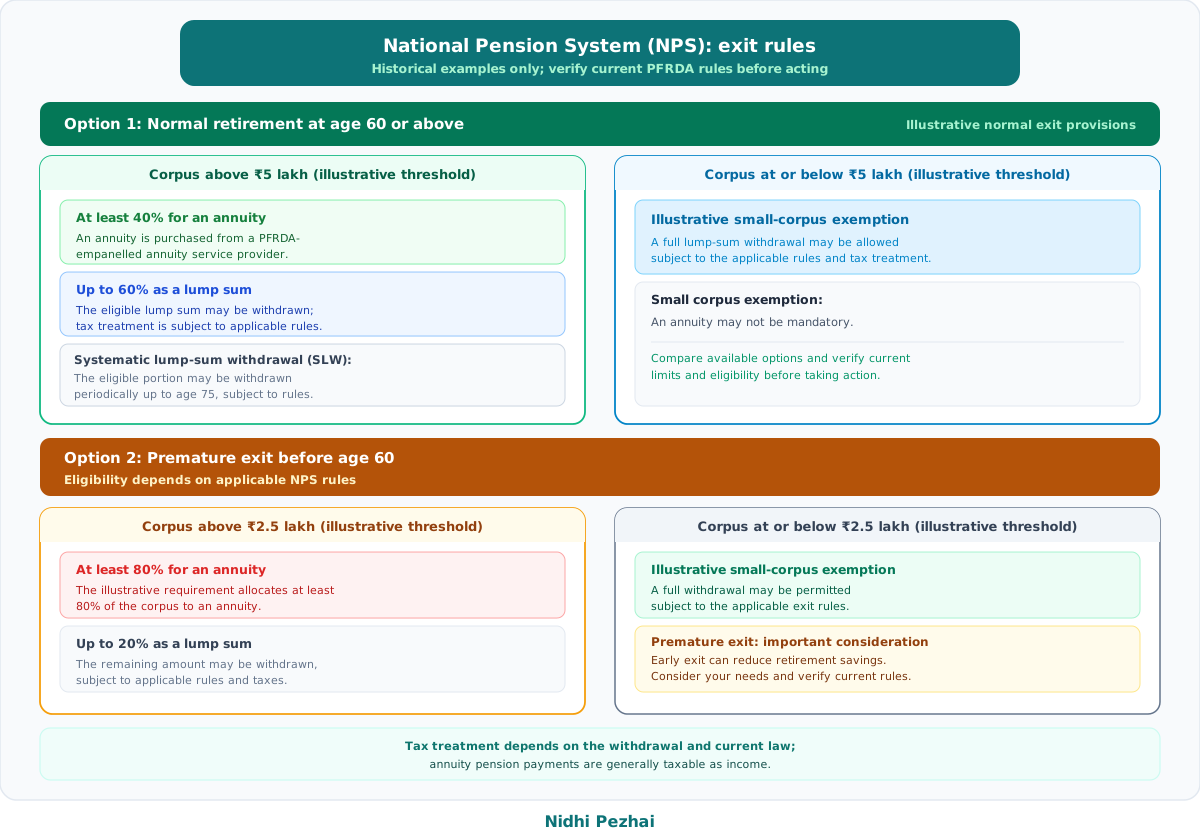
1. Normal Retirement at Age 60 or Above (Superannuation / Exit at 60+)40% Mandatory
Minimum 40% annuity mandate: Upon reaching 60 years of age, you are legally required to utilize at least 40% of the accumulated NPS corpus to purchase an annuity policy from a PFRDA-empanelled Annuity Service Provider (ASP).
Up to 60% lump-sum withdrawal: The remaining 60% of the corpus can be withdrawn as a lump sum. Under Section 10(12A) of the Income Tax Act, this entire 60% lump sum is 100% tax-free.
Important small corpus exemption: If your total accumulated NPS corpus on the date of superannuation is ₹5,00,000 (₹5 lakh) or less, you are exempt from buying an annuity. You are permitted to withdraw 100% of the corpus as a completely tax-free lump sum!
2. Premature Exit Before Age 60 (Premature Exit before 60)80% Mandatory
If a subscriber has completed at least 5 years in NPS and chooses voluntary early retirement before age 60:
It is mandatory to use at least 80% of the accumulated corpus to purchase an annuity.
Only 20% of the corpus can be withdrawn as a lump sum.
Exemption: For premature exits, 100% lump-sum withdrawal is permitted only if the total accumulated corpus is ₹2,50,000 (₹2.5 lakh) or less.
3. In Case of Subscriber's Demise (Death of Subscriber)Family Protection
All Citizens Model: In the event of the subscriber's demise, the nominee has the right to receive 100% of the corpus as a lump sum, or elect to purchase an annuity.
Government Sector Subscribers: If a government employee passes away while in service, government rules require that at least 80% of the corpus be utilized to purchase a default family pension annuity for the surviving spouse.
The SLW facility introduced by PFRDA allows subscribers to withdraw their 60% lump-sum entitlement in periodic monthly, quarterly, semi-annual, or annual instalments up to age 75, rather than taking it all at once.
Please note: This SLW facility applies only to the 60% lump-sum portion; the requirement to purchase an annuity with the remaining 40% continues without change.
6. Leading Annuity Providers in India (Annuity Service Providers / ASPs)
Leading life insurance companies empanelled by IRDAI and PFRDA to offer annuities under NPS and open retail markets are designated as Annuity Service Providers (ASPs):
Leading Annuity Providers and Their Flagship PlansASP Directory
Life Insurance Corporation of India (LIC):
India's largest state-owned life insurer, enjoying the highest level of public trust.
Popular schemes:LIC Jeevan Akshay-VII (Immediate Annuity), LIC Jeevan Shanti (Deferred Annuity), LIC Saral Pension (Standardized immediate annuity plan mandated by IRDAI).
SBI Life Insurance:
Subsidiary of India's largest public sector lender, State Bank of India.
Popular schemes:SBI Life - Annuity Plus, SBI Life - Saral Pension.
HDFC Life Insurance:
Leading private insurer commanding significant annuity market share.
Popular schemes:HDFC Life Smart Pension Plus, HDFC Life Systematic Retirement Plan.
Known for efficient customer service and guaranteed long-term income products.
Popular scheme:Max Life Guaranteed Lifetime Income Plan.
Bajaj Allianz Life Insurance:
Popular scheme:Bajaj Allianz Life Guaranteed Pension Goal.
Other Empanelled Insurers: Tata AIA Life, Kotak Mahindra Life, Aditya Birla Sun Life, IndiaFirst Life.
How to Compare Annuity Rates?
Rates vary by age of entry: Annuity rates are tied directly to the age at which you purchase the policy. For example, an investor buying at age 70 will receive a noticeably higher monthly pension for a ₹10 lakh purchase price than an investor buying at age 60. This is because life expectancy at age 70 is shorter, enabling insurers to offer higher payout yields.
Rate disparities between insurers: For the exact same policy option, one insurer might quote 6.3% while another offers 6.75%. Even a 0.5% annual rate difference compounds into several lakhs of rupees over a 25 to 30-year retirement. Always compare live quotes on the PFRDA portal or official insurer portals before making a choice.
Locking 100% of your retirement capital into a single annuity product is rarely optimal. India offers several robust, sovereign-backed or market-linked alternatives that can complement or substitute annuity plans:
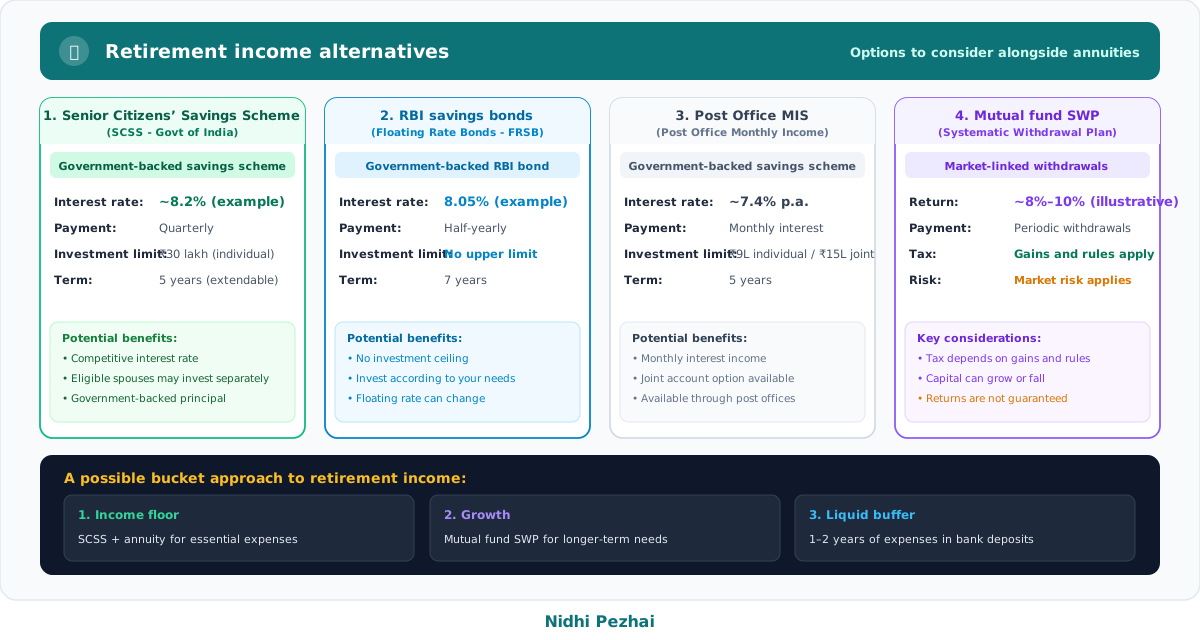
1. Senior Citizens Savings Scheme (SCSS)8.2% Sovereign Yield
Safety: 100% Government of India sovereign guarantee.
Income: Interest is credited directly to your bank account every quarter (currently offering 8.2% per annum—significantly higher than standard annuity rates).
Tenure: 5 years (extendable by an additional 3-year block upon maturity).
Investment ceiling: Maximum ₹30 lakh per individual (a married couple can invest up to ₹30 lakh each, for a combined total of ₹60 lakh).
Safety: 100% sovereign bond issued by the Government of India via the Reserve Bank of India (RBI).
Income: The interest rate is semi-floating, permanently pegged at 0.35% above the prevailing National Savings Certificate (NSC) rate (currently yielding 8.05%). Interest is credited semi-annually directly to your bank account.
Investment ceiling: No upper cap; investors can deploy any amount without limit.
Tenure: 7 years.
3. Post Office Monthly Income Scheme (POMIS)Monthly Payout
Safety: Direct sovereign safety backed by the Department of Posts, Government of India.
Income: Fixed monthly interest credited to your savings account (currently around 7.4% per annum).
Investment ceiling: ₹9 lakh for a single account; up to ₹15 lakh for a joint account.
Tenure: 5 years.
4. Mutual Fund Systematic Withdrawal Plan (SWP)Inflation Growth & Tax Efficiency
How it works: Allocate retirement capital into conservative hybrid funds or balanced advantage funds and set up an automated monthly cash payout via a Systematic Withdrawal Plan (SWP).
Tax advantage: Unlike annuities or bank FDs where the entire payout/interest is taxed at slab rates, SWP redemptions are subject to capital gains tax only on the profit component of each withdrawal. This significantly boosts post-tax take-home cash flow.
Capital appreciation: Offers the potential to beat inflation with long-term expected returns of 8% – 10%, allowing your principal corpus to continue growing.
Caution: Subject to market risk and short-term portfolio volatility.
Annuity Tax Treatment and TDS RegulationsIncome Tax Rules
Monthly pension is fully taxable:
The regular pension income received from an annuity (monthly, quarterly or annually) is treated as taxable income under the Income Tax Act. It is categorized under 'Income from Other Sources' (or 'Salaries/Pension' for employment superannuation) and taxed at your applicable income tax slab rates.
Return of Purchase Price is tax-free:
Upon the demise of the annuitant, the lump-sum principal refunded to the nominee under Return of Purchase Price (ROP) options is generally 100% tax-exempt under Section 10(10D) of the Income Tax Act.
Tax Deducted at Source (TDS) and Form 15H:
Life insurance companies deduct TDS if total annual annuity payments exceed statutory limits. Senior citizens whose total estimated taxable income falls below the exemption limit can submit Form 15H at the beginning of each financial year to avoid TDS deductions.
10. Retirement Income Strategy: The 3-Bucket Approach
The single most critical rule shared by retirement planners is: "Never put all your retirement eggs into one single basket."
During retirement, you require capital safety and liquidity for day-to-day living, while simultaneously needing capital growth to combat inflation and rising healthcare costs over a 20 to 30-year horizon. A hybrid 3-bucket strategy balances these priorities:
Structuring Your Retirement Portfolio Across 3 Buckets3-Bucket Framework
Bucket 1: Immediate Liquidity & Emergency Buffer (10% to 15%):
Keep 1 to 2 years of living expenses plus an emergency medical buffer in liquid funds, high-yield savings accounts, or short-term bank FDs.
Bucket 2: Guaranteed Monthly Floor Income (50% to 60%):
Secure your non-negotiable living expenses (groceries, utilities, medicines, maintenance) by distributing funds across government-backed SCSS and life annuities with ROP. Even if markets undergo severe downturns, your monthly floor income arrives on time.
Bucket 3: Inflation Defense & Capital Growth (25% to 35%):
Deploy this portion into conservative hybrid, balanced advantage, or multi-asset allocation mutual funds, drawing a modest 5% to 6% SWP. This segment works to preserve purchasing power and counter long-term inflation.
1. Can an annuity policy be surrendered early to retrieve the principal? (Surrender Value)Key Regulation
Answer: In general, traditional annuity policies cannot be surrendered once purchased (no premature surrender). However, under recent IRDAI directives, insurers allow surrender under specific hardship circumstances, such as when the annuitant or immediate family member is diagnosed with a critical illness, subject to applicable surrender charges. Always evaluate liquidity needs carefully before locking in funds.
2. What happens to my pension if a private insurance company goes bankrupt?Safety Norm
Answer: Life insurance companies in India operate under the stringent regulatory oversight of IRDAI. By law, insurers must maintain a solvency ratio of at least 150%, meaning assets significantly exceed liabilities. No Indian life insurer has ever failed to honor policyholder commitments. Furthermore, regulatory resolution frameworks typically mandate the transfer and merger of distressed policyholder portfolios into financially robust institutions to safeguard pension continuity.
3. At age 60, is it better to buy an annuity or invest in SCSS?Allocation Strategy
Answer: A blended approach is optimal. SCSS currently yields a higher interest rate of 8.2%, but its rate is locked for only 5 years (with a possible 3-year extension). If macro interest rates fall after 5 years, reinvestment risk kicks in. Therefore, max out the ₹30 lakh SCSS limit first for superior near-term yield, and allocate remaining core retirement funds to a lifetime annuity to permanently lock in guaranteed floor income for life.
4. Can I convert more than 40%—or even 100%—of my NPS corpus into an annuity?NPS Rule
Answer: Yes, absolutely. The NPS rule requiring a 40% annuity allocation is merely the minimum mandatory threshold. If you have adequate liquid funds elsewhere and prefer maximizing your guaranteed lifelong monthly pension, you are fully entitled to convert 80% or even 100% of your NPS corpus into an annuity.
5. When are annuity rates locked in? Can they change after purchase?Rate Lock
Answer: Your annuity rate is permanently locked on the date the policy is issued, based on prevailing interest rates at that time. Once the policy document is executed, the insurance company cannot reduce your payout rate under any circumstances, even if benchmark interest rates fall towards zero. The contracted payout remains fixed for life.
5 essential checks before purchasing an annuity policy:
Do you actually need an annuity? If you already receive an inflation-indexed government pension or substantial rental income covering all living expenses, an annuity may be redundant. Annuities are primarily for those lacking guaranteed floor income.
Prioritize Return of Purchase Price (ROP): If passing your capital to your heirs or surviving spouse is important, choose 'Life Annuity with Return of Purchase Price' or 'Joint Life with ROP'.
Check NPS small-corpus exemptions: If your accumulated NPS corpus is ₹5 lakh or less at superannuation, you can withdraw 100% tax-free without buying an annuity, and redirect those funds to higher-yielding avenues like SCSS.
Compare rates across leading ASPs: Compare prevailing payout rates across major providers like LIC, SBI Life, HDFC Life, and ICICI Prudential on the PFRDA or IRDAI portals to capture the most competitive rate.
Factor in tax implications: Remember that annuity pension payouts are taxable at your personal income tax slab rate. Plan your monthly post-tax cash flows accordingly.