Real EstateProperty LawLegal AwarenessPersonal FinanceInvesting
Hidden Encumbrances and Legal Pitfalls in Real Estate Investments in India
An in-depth analysis of hidden encumbrances, title defects, and legal risks in Indian real estate investments, comparing equities vs land, 15 real-world court cases, Chennai builder traps, and essential due diligence strategies.
"Money put into land never goes to waste", "Invest in soil and it turns to gold"—these are familiar adages passed down across generations in Indian families. The enduring affinity Indians have for gold and real estate stems primarily from tangibility: they are physical assets that you can see, touch, and walk upon.
Across social media and informal peer conversations, simplified advice abounds: "The stock market is gambling and volatile; but buy a plot of land or a house, and your wealth is secure for generations."
Yet, the harsh legal reality is quite the opposite: Real estate investments carry far more invisible, unpredictable hidden encumbrances, title defects, and legal storms capable of wiping out a lifetime's savings than equity investments ever will!
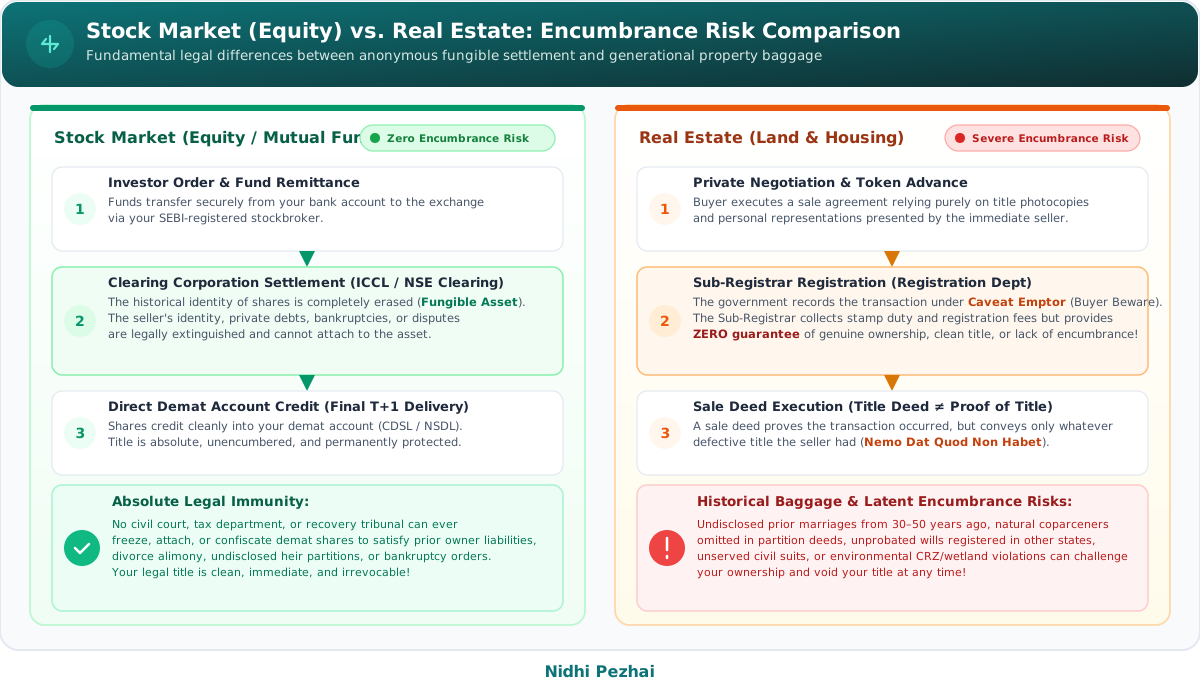
Equity vs. Real Estate: Anonymous Settlement vs. Generational Baggage
To understand the vulnerability of real estate, one must first appreciate the profound legal and operational difference between stock markets and immovable property.
1. What Happens in the Stock Market (Equities / Mutual Funds)?
Suppose you purchase 100 shares of a company through your brokerage account:
Funds move from your bank account to the stockbroker.
From there, money flows to the exchange's clearing entity (Clearing Corporation - ICCL / NSE Clearing).
Simultaneously, shares move from the seller's demat account to the clearing corporation and are credited directly into your demat account.
The Crucial Legal Reality:
During this settlement process, the prior historical identity of the shares is completely wiped away (Fungible Asset). Who originally owned those shares? Who held them 10 years ago? Does the seller have an ongoing divorce dispute, family feud, or mounting bankruptcy proceedings? None of it can touch your shares.
The second settlement completes, those shares are unequivocally yours. No civil court can attach, freeze, or confiscate the shares in your demat account to satisfy the personal liabilities of a previous owner!
2. What Happens in Real Estate (Immovable Property)?
Land, individual houses, and apartments are never fungible or anonymous!
Every single piece of land you acquire arrives encumbered by 30, 50, or even 100 years of historical human baggage—unregistered marriages, undisclosed natural heirs omitted in partition deeds, minor rights, and unrecorded court litigations.
The immediate seller might be perfectly honest; but the forgotten heirs of a predecessor who owned the land three decades ago, or an unextinguished third-party easement, can knock on your door at any time.
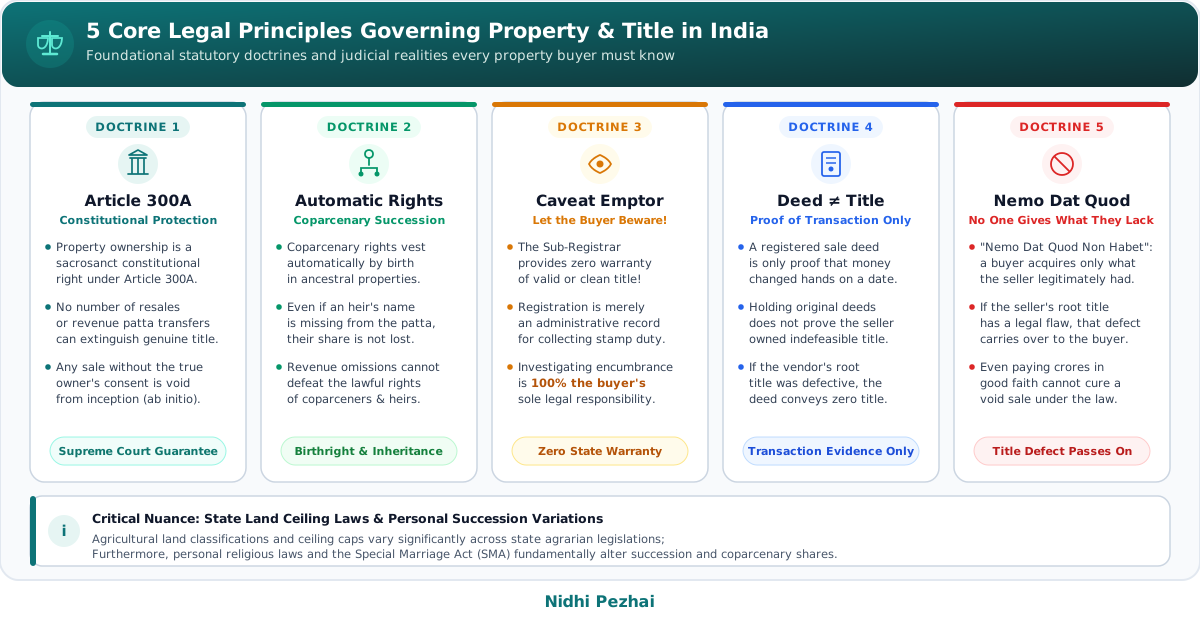
5 Core Legal Principles Governing Property & Title in India
Every property buyer must understand the foundational legal doctrines applied by Indian courts in real estate disputes:
1. Article 300A: Constitutional Right to PropertyConstitutional Protection
Under Article 300A of the Constitution of India, property ownership is a constitutionally protected right. If an individual possesses valid statutory title to an immovable asset, no number of subsequent sales, forged registrations, or administrative revenue mutations (Patta changes) can extinguish that title without the true owner's lawful consent or due process of law.
2. Automatic Property Rights (Operation of Law)Automatic Succession
Statutory inheritance and coparcenary rights vest automatically by operation of law. Even if a rightful heir's name is inadvertently omitted from local revenue records (Patta, Chitta), or municipal officials commit an administrative recording error, or an interim court order was improperly passed, the lawful heir's title remains legally valid and enforceable.
3. Caveat Emptor (Buyer Beware)Buyer's Burden
When you register a sale deed at the Sub-Registrar's Office (SRO), neither the registration department nor the state government provides any guarantee of clear title!
The Registration Department is merely a revenue-collecting administrative body that charges stamp duty and registration fees to register an instrument. Under the common law doctrine of "Caveat Emptor", verifying root title, chain of ownership, and hidden encumbrances rests 100% on the buyer.
4. Title Deed is Proof of Transaction, NOT Proof of TitleTransaction Record Only
A widespread misconception is: "I hold the original registered sale deed, so I am the absolute owner."
Legally, a registered sale deed is merely evidence that a financial transaction took place between buyer and seller on a specific date (Proof of Transaction). If the seller lacked good, marketable root title (Proof of Title), the sale deed conveys zero valid ownership to the buyer.
5. Nemo Dat Quod Non Habet (No One Can Transfer What They Do Not Own)Defective Title Persists
"Nemo Dat Quod Non Habet" is a bedrock legal principle: a buyer can acquire no better title than what the seller actually possessed. If the seller held a defective or encumbered title, the buyer inherits that exact defect—regardless of whether they paid market price in good faith as a bona fide purchaser.
6. Discrepancies in State Land Laws & Personal Succession ActsConflicting Statutes
India has no unified nationwide property code. Agricultural ceiling limits, tenancy laws, and land conversion regulations differ markedly between states (e.g., Tamil Nadu, Kerala, Karnataka). Concurrently, personal religious succession laws and the Special Marriage Act (SMA) create intricate legal conflicts that directly impact property title.
15 Real-World Case Studies Illustrating Hidden Encumbrances
The cases below are not fictional scenarios; they are based on actual litigations fought in Indian courts that resulted in catastrophic financial losses for unsuspecting buyers:
Summary Comparison Matrix of the 15 Cases
#
Case & Scenario
Hidden Encumbrance / Legal Defect
Affected Buyer
Outcome & Financial Loss
1
Kochi Maradu Flat Demolition(Environmental)
Coastal Regulation Zone (CRZ) violation; invalid panchayat building permit
Sundaramurthy
345 luxury flats blown up by explosives; banks refused loan waivers and enforced full EMI collection
2
The Runaway 3rd Son(Partition Omission)
Coparcenary birthright of omitted son under Section 6 of HSA
Karthikeyan
Son returned after 5 years and was awarded 1/3rd share; buyer's house and land frozen
3
The Hidden First Marriage(Unregistered Marriage)
Undissolved first marriage; second wife's sale deed legally void
Senthilnathan
Court ruled first wife sole legal heir; buyer lost acquired land and entire investment
4
Subsequent Will in Another City(Will Conflict)
Later Will registered secretly in Delhi revoking earlier Coimbatore Will
Ilangovan
Later Delhi Will held valid; sale deed by beneficiary of earlier Will cancelled; land lost
5
Couple Dying One Day Apart in Crash(Timing Gap)
Wife died first (50% passed to husband); husband died next day (passed to his 19 relatives)
Muralidharan
Wife's 14 relatives sold 100% without authority; husband's 19 heirs sued and froze property
6
Special Marriage Act (SMA) Twist(ISA 1925)
SMA marriage governed exclusively by Indian Succession Act 1925; mother had zero inheritance share
Baskaran
Mother's sale of 1/3rd share declared void; buyer lost substantial capital
7
Divorce Judgment Delayed 6 Days(Spouse at Demise)
Husband suffered fatal heart attack before decree was signed; still legally married
Gunasekaran
Wife declared sole legal heir; sale deed executed by deceased husband's brothers quashed
8
Areca Nut Replacing Coconut(Ceiling Surplus)
Change of crop altered ceiling limits under Land Reforms Act; declared government surplus
Manimaran
Land included in surplus pool and confiscated by government; home lost
9
Court Suit 300 km Away(Attachment Order)
Interim attachment order passed by distant family court prior to sale registration
Arivalagan
Court attachment order took precedence over deed; property frozen in protracted litigation
10
Grandson Born Days Before 1976 Act(Kerala Joint Family)
Born days prior to Kerala Joint Hindu Family System Abolition Act, retaining birthright
Nedunchezhiyan
Daughters' sale challenged by grandson; court awarded his share; buyer suffered heavy loss
11
Inter-Faith Temple Marriage(Void Marriage)
Inter-faith marriage without SMA registration declared null and void
Dharmalingam
Wife held to have no inheritance rights; deceased's brothers recovered estate; buyer evicted
12
Imposter in Guardianship Order(Fraudulent Order)
Imposter posed as minor's father to obtain court sale permission
Rajendran
Upon minor reaching 18, fraud uncovered; court order quashed; buyer lost land
13
SMA Marriage Entangled After 30 Yrs(Personal Law)
Complex interplay between personal laws and SMA triggered litigation 30 years later
Vijayaraghavan
Decades-old marriage challenged by siblings; buyer entangled in prolonged civil suit
14
Chennai Builder Project Loan(SARFAESI Auction)
Builder mortgaged entire land to NBFC for ₹35 Cr project loan and defaulted (No NOC / Release)
Saravanakumar
Despite paying EMIs regularly, bank pasted SARFAESI auction notice on apartment gates
15
Missing CMDA Completion Certificate(Power Cut)
Plan deviation meant builder could not get CC; sold with village panchayat letter
Natarajan
High Court ordered TANGEDCO power cut; CMDA issued Lock & Seal notice; buyer displaced
Detailed Case Breakdowns (Click to Expand)
Case 1: Kochi Maradu Demolition (CRZ Violations & 310 Bank Loans)Environmental Violation
Facts: In Maradu, Kochi (Kerala), 4 luxury high-rise complexes comprising 345 waterfront apartments were constructed along scenic backwaters. Over 310 buyers, including Sundaramurthy, secured home loans from India's leading scheduled commercial banks after institutional legal teams verified title documents.
The Legal Defect: The apartments were constructed in flagrant violation of Coastal Regulation Zone (CRZ-III) environmental notifications, operating solely on unauthorized panchayat permits.
Outcome: The Supreme Court of India ordered the controlled implosion of all 4 complexes. In January 2020, the towers were blasted into rubble. The banks suffered zero losses; under loan contracts, borrowers remained strictly liable to repay their monthly EMIs. Hundreds of middle-class families lost their life savings overnight while continuing to service debt on non-existent properties.
Case 2: The Runaway 3rd Son (Partition Omission)Partition Defect
Facts: Following the demise of patriarch Ramanathan, his two sons, Selvam and Kumar, obtained a legal heir certificate, partitioned the ancestral land, and sold it to Karthikeyan, who constructed a residential home.
The Legal Defect: Five years later, an individual named Sakthivel filed a suit. Ramanathan had a third son, Sakthivel, who had run away from home as an adolescent. He was never legally declared dead under Section 108 of the Evidence Act.
Outcome: The court affirmed Sakthivel's unalienable 1/3rd coparcenary birthright. A partition decree was issued; Karthikeyan's property was legally encumbered, resulting in severe financial loss.
Case 3: The Hidden First Marriage (Unregistered Marriage & Invalid 2nd Wife)Void Marriage
Facts: Muthiah passed away. His wife, Kavitha, presented revenue records listing her as sole legal heir and sold the self-acquired land to Senthilnathan.
The Legal Defect: Four years later, Meenakshi moved the court. Decades earlier, Muthiah had lawfully wed Meenakshi in a traditional ceremony. Though unregistered, under the Hindu Marriage Act, the marriage was fully valid, and no decree of divorce had ever been granted.
Outcome: Under Section 5(i) and Section 11 of the Hindu Marriage Act, a second marriage during the subsistence of a first marriage is void ab initio. Kavitha was legally not a spouse and had zero inheritance rights. Meenakshi was declared the sole heir; Senthilnathan's sale deed was nullified.
Case 4: Subsequent Will Registered in Another City (Coimbatore vs. Delhi)Subsequent Will
Facts: Palanisamy passed away in 2016. In 2002, he had executed a registered Will in Coimbatore bequeathing property to his niece Ramya. Ramya sold the property to Ilangovan. An Encumbrance Certificate (EC) obtained in Coimbatore showed no encumbrances.
The Legal Defect: Three years later, Palanisamy's nephew Prakash challenged the sale. In 2012, while residing in Delhi, Palanisamy had executed and registered a fresh Will at a Delhi SRO revoking all earlier Wills and bequeathing the property to Prakash.
Outcome: Under the Indian Succession Act, the Last Will and Testament prevails. Because local EC searches only index instruments within that SRO's jurisdiction, the Delhi Will was invisible in Coimbatore. The property vested in Prakash, and Ilangovan was dispossessed.
Case 5: Couple Dying One Day Apart in a Crash (Timing Gap & 19 Relatives)Succession Timing
Facts: A childless elderly couple, Damodaran and Susheela, were involved in a serious road collision. Property held solely in Susheela's name was subsequently sold by her 14 surviving blood relatives to Muralidharan.
The Legal Defect: Hospital records established that Susheela succumbed to injuries at the crash scene, whereas Damodaran survived on life support until the next morning. During that single day, 50% of Susheela's estate legally devolved upon Damodaran under Section 15 of the Hindu Succession Act. Upon Damodaran's death the next morning, that 50% passed to Damodaran's 19 heirs.
Outcome: Susheela's relatives had authority to convey only 50%. Damodaran's 19 heirs filed suit, and Muralidharan was saddled with an encumbered, half-owned asset.
Case 6: Special Marriage Act (SMA) Permanent Twist (Mother Denied Share)SMA Conflict
Facts: Sivakumar died intestate. Believing Hindu Succession Act applied, his mother Meenakshi sold her presumed 1/3rd share to Baskaran. Later, wife Lakshmi and son Aravind sold the remaining 2/3rds to Baskaran.
The Legal Defect: Decades prior, Sivakumar had married Mary under the Special Marriage Act (SMA), 1954. Under Section 21 of the SMA, succession to the property of any person whose marriage is solemnized under SMA is governed permanently by the Indian Succession Act, 1925—even in subsequent marriages. Under ISA 1925, where a widow and lineal descendants survive, the mother inherits zero!
Outcome: Mother Meenakshi had no title whatsoever. Her sale of the 1/3rd share was declared void, inflicting heavy financial losses on Baskaran.
Case 7: Divorce Decree Delayed 6 Days by Judge's Leave (Still Wife at Demise!)Divorce Delay
Facts: Saravanan and Priya underwent bitter divorce proceedings in family court. Final arguments concluded and the matter was reserved for judgment. Days later, Saravanan suffered a fatal heart attack. Saravanan's brothers treated the marriage as effectively over and sold his land to Gunasekaran.
The Legal Defect: The presiding judge had taken sudden medical leave. The formal divorce decree was signed and pronounced 6 days after Saravanan's demise.
Outcome: At the exact moment of death, Saravanan was legally married. An unpronounced judgment confers no legal dissolution. Priya remained the lawful widow and sole Class-I heir; Gunasekaran's purchase from the brothers was quashed.
Facts:Manimaran purchased one acre of agricultural land from farmer Natarajan and constructed a home, residing there peacefully for 8 years.
The Legal Defect: In year 8, revenue authorities issued a seizure notice under Land Reforms (Land Ceiling) statutes. Natarajan held fragmented agricultural land parcels across several villages. Under land reform formulas, ceiling allowances for coconut plantations and areca nut plantations differ fundamentally. When Natarajan shifted from coconut to areca nut cultivation, his allowable ceiling was exceeded, rendering several parcels statutory "surplus land".
Outcome: Under ceiling statutes, transactions involving surplus land are void ab initio. The government took possession of the land; Manimaran lost his home.
Case 9: Family Court Suit 300 km Away (Attachment Order Prior to Sale)Court Attachment
Facts: Pugazhendhi sold his self-acquired vacant plot to Arivalagan. All title deeds and encumbrance certificates were clean.
The Legal Defect: 300 km away in his hometown, Pugazhendhi's wife had initiated maintenance litigation and petitioned for property attachment. The family court granted an interim attachment order. Before the certified court order could be dispatched to the jurisdictional Sub-Registrar, Pugazhendhi rushed the registration.
Outcome: Under procedural law, a court attachment order takes effect from the date of the order, not the date the SRO registers the notice. The sale was subordinated to the court's attachment, entangling Arivalagan in lengthy litigation.
Case 10: Grandson Born Days Before Kerala Joint Family Abolition Act (1976)Joint Family Birthright
Facts: A mother passed away. Her two daughters inherited ancestral land and sold it in 2016 to Nedunchezhiyan.
The Legal Defect: In 2020, a young man named Raghavan filed a partition suit. Raghavan was the son of one of the daughters. He had been born in November 1976—just days before the Kerala Joint Hindu Family System (Abolition) Act took effect on December 1, 1976!
Outcome: Because he was born prior to the abolition date, his coparcenary birthright vested under joint family law. The court awarded his rightful share; Nedunchezhiyan suffered severe financial impairment.
Case 11: Inter-Faith Temple Marriage Without SMA Registration (Void Marriage)Void Marriage
Facts: Velayutham died childless. His inter-faith partner Nasreen, holding local panchayat marriage records, claimed sole heirship and sold the property to Dharmalingam.
The Legal Defect: Three years later, Velayutham's brothers filed suit. Velayutham and Nasreen had married in a local temple ceremony without converting or solemnizing under the Special Marriage Act. In India, an inter-faith marriage solemnized under religious rites without formal statutory registration under SMA is void.
Outcome: Nasreen had no legal status as a surviving spouse. Velayutham's brothers reclaimed the estate; Dharmalingam lost the property and his capital.
Case 12: Imposter in Guardianship Court OrderImposter Fraud
Facts: Sundaram bequeathed land to his minor nephew via a registered Will. An individual claiming to be the minor's father obtained court permission to sell the property under the Guardians and Wards Act and conveyed the land to Rajendran.
The Legal Defect: Years later, when the nephew attained 18 years of age, he challenged the transaction. Due to a family feud, an imposter had impersonated the father before the district court to secure the sale order.
Outcome: Because the genuine guardian had never petitioned the court, the court order was obtained via fraud on the court (fraud vitiates all solemn acts). The order was quashed, and Rajendran was dispossessed.
Case 13: SMA Marriage Entangled with Personal Laws 30 Years LaterPersonal Law Conflict
Facts: Syed married Anitha under the Special Marriage Act. After Syed passed away childless, Anitha and Syed's brother Mubarak sold the property in 2015 to Vijayaraghavan.
The Legal Defect: Later judicial rulings highlighted complex exceptions where personal succession laws intersect with SMA. Mubarak subsequently claimed the entire property under Shariat rules, challenging Anitha's legal entitlement after 30 years of peaceful marriage.
Outcome: Vijayaraghavan was entangled in expensive appellate litigation that froze his investment.
Case 14: Chennai Builder Project Loan & SARFAESI Bank Auction NoticeSARFAESI Risk
Facts: In an OMR Chennai suburb, Saravanakumar booked a flat for ₹80 Lakh (₹20L own savings + ₹60L home loan from a scheduled bank). The builder registered the sale deed, and Saravanakumar moved in, servicing his EMIs punctually every month.
The Legal Defect: Prior to breaking ground, the developer had mortgaged the entire parcel to a major NBFC for a ₹35 Crore Project Construction Loan. After pocketing flat buyers' funds, the builder defaulted on the project loan and absconded.
Outcome: The NBFC initiated proceedings under the SARFAESI Act, 2002, pasting an auction notice on the apartment's main gate. Because the developer never executed an individual "No Objection Certificate (NOC)" or a registered "Deed of Partial Release" with the SRO for Saravanakumar's unit, the lender's first charge remained intact. Saravanakumar faced the nightmare of continuing his personal loan EMIs while defending his home from bank auction.
Case 15: Missing CMDA Completion Certificate (CC) & Power Cut (Panchayat Letter Fraud)CMDA CC Defect
Facts: In suburban Chennai, Natarajan bought a flat in a newly completed complex. The developer displayed a local village panchayat letter claiming building completion and handed over keys.
The Legal Defect: The developer had severely violated the CMDA-sanctioned plan, adding extra floors and ignoring setback mandates. Consequently, the CMDA refused to issue a Completion Certificate (CC). Under Madras High Court rulings (P. Anandasundaresan v. M/s. Akshaya Pvt. Ltd.), utility providers (TANGEDCO / CMWSSB) are legally prohibited from granting permanent electricity or water connections to buildings lacking a valid CMDA/DTCP Completion Certificate; village panchayat letters are not legal CCs.
Outcome: TANGEDCO disconnected the temporary construction power line. The CMDA issued a Lock & Seal notice. Natarajan was forced to vacate his new apartment with his family.
"The Bank's Lawyer Checked Everything, Why Worry?" — The Great Myth!
A common complacency among Indian middle-class home buyers is: "We took our home loan from SBI or HDFC; their legal panel vetted 30 years of documents before releasing funds. Surely the property is 100% safe!"
This assumption is dangerously flawed:
Whose Interests Does the Bank Panel Lawyer Serve?
The bank's legal counsel verifies documents solely to protect the bank's disbursed principal—not your down payment, emotional security, or life savings.
The Maradu Demolition is Living Proof:
Of the 345 demolished luxury apartments in Kochi, 310 had received full legal clearance and home loans from India's premier scheduled banks! Even after the Supreme Court demolished the buildings, banks vigorously pursued the owners for full loan repayment (The Hindu Investigative Report & Supreme Court Order on Loan Interest).
The Bank's Legal Position:
If a property is sealed, attached, or demolished, the lending bank suffers no financial loss. Under the personal loan agreement you signed, you remain personally liable to repay the loan in full. If you default, the bank has full statutory authority to attach your salary, savings, gold, and other personal assets!
5 Specific Builder Pitfalls Faced by Flat Buyers in Chennai & Tamil Nadu
While standalone plots suffer mostly from family succession disputes, apartment buyers in metropolitan areas like Chennai face commercial, regulatory, and municipal traps:
Summary Comparison Matrix of Chennai Builder Traps
#
Builder Trap / Risk
Legal Root Cause & Reality
Impact on Flat Buyer
Mitigation Strategy
1
Builder's Project Loan
SARFAESI Act 2002; lender holds first charge over entire land parcel
Bank auction notice on gate despite buyer paying 100% EMIs
Obtain bank NOC & verify registered Partial Release Deed at SRO
2
Missing CMDA CC
Deviations from sanctioned plan; panchayat letters are legally invalid
TANGEDCO power cut & CMDA Lock & Seal notice
Insist on official CMDA/DTCP Completion Certificate before final payment
3
TNRERA Approval Myth
TNRERA is a regulatory body, not a civil court; does not certify root title
Civil court injunction freezes project; RERA registration cannot save it
Independent 30–50 year parent document scrutiny by your lawyer
4
UDS Fraud & Selling Common Areas
Total UDS sum less than land size; illegal sale of terrace and stilt parking
Developer constructs illegal extra floors; loss of terrace & parking rights
Ensure total unit UDS equals 100% of land (Abbotsbury, AVN rulings)
5
Waterbody & Wetland Encroachment
Building in lake surplus channels violating NGT & CRZ norms
Before breaking ground, most developers borrow tens of crores by mortgaging the entire project land to banks or NBFCs.
The Hidden Risk: Even if you pay 100% of your flat's price, unless the developer secures a specific "No Objection Certificate (NOC)" from the lending institution and registers a "Deed of Partial Release" at the Sub-Registrar Office, the lender's primary mortgage (First Charge) continues over your flat's undivided share of land (UDS).
The Consequence: If the developer defaults on the project loan, the lender can enforce the SARFAESI Act, 2002, issuing attachment and auction notices against the complex.
Mitigation: Prior to registration, verify that your specific flat is covered under a registered Deed of Release from the project lender.
Developers frequently violate approved setback rules or add unauthorized floors, making it impossible to obtain an official Completion Certificate (CC) from the CMDA or DTCP.
The Panchayat Letter Trick: Developers often procure informal letters from village panchayats to dupe buyers into taking possession.
Madras High Court Ruling: In P. Anandasundaresan v. M/s. Akshaya Pvt. Ltd., the Madras High Court ruled that:
A panchayat letter is not a valid Completion Certificate.
Utility authorities (TANGEDCO for electricity and CMWSSB for water/sewerage) are legally prohibited from providing permanent connections without a valid CMDA/DTCP Completion Certificate.
The Consequence: Buyers face abrupt power disconnections and CMDA Lock & Seal enforcement.
Mitigation: Never accept keys or disburse final payments without verifying the genuine Completion Certificate published on the CMDA portal.
Trap 3: "TNRERA Approved Project" Does NOT Equal Clear TitleCivil Injunctions
Buyers frequently place blind trust in advertisements proclaiming "TNRERA Approved".
The Reality: TNRERA is a regulatory body formed to monitor construction timelines and penalize handover delays; it is not a competent Civil Court empowered to adjudicate root ownership.
The Defect: If underlying parent deeds contain undisclosed legal heirs or title defects, a civil court can issue an injunction halting the project. A TNRERA registration number provides zero defense against civil litigation.
Mitigation: Use TNRERA registration only as construction oversight, but conduct independent 30- to 50-year parent document due diligence through your personal property advocate.
Major legal battles fought in the Madras High Court (such as Abbotsbury Owners Association and AVN Flat Owners Association) spotlight systemic UDS manipulation:
UDS Under-allocation: Summing the UDS allocated across all registered flats often yields a total less than the project's actual land area. Builders retain the residual UDS to construct unauthorized extra structures or pocket future redevelopment gains.
Illegal Sale of Common Areas: Open/stilt car parking, terraces, and clubhouses belong collectively to the Association of Apartment Owners (AOA). Developers have zero legal right to sell terraces or car parks to individuals.
Mitigation: Calculate whether the sum of all flat UDS equals 100% of the surveyed land area before executing agreements.
Following the catastrophic Chennai floods in 2015 and 2023 (Cyclone Michaung), the Southern Zone of the National Green Tribunal (NGT) and the Madras High Court have cracked down aggressively on waterbody encroachments.
Vulnerable Corridors: Apartment complexes developed along surplus channels of Pallikaranai marshlands, Velachery, Ambattur, Korattur, and Tambaram lakes face scrutiny for buffer-zone violations.
The Consequence: Beyond seasonal flooding, properties constructed on classified watercourses face demolition notices from revenue authorities.
Mitigation: Review the CMDA Master Plan land use classification, survey maps (FMB), and waterbody buffers before paying token advances.
Recognize that real estate is not an infallible, risk-free asset class. It is inherently entangled with multi-generational human relationships, unrecorded family secrets, and complex legal conflicts.
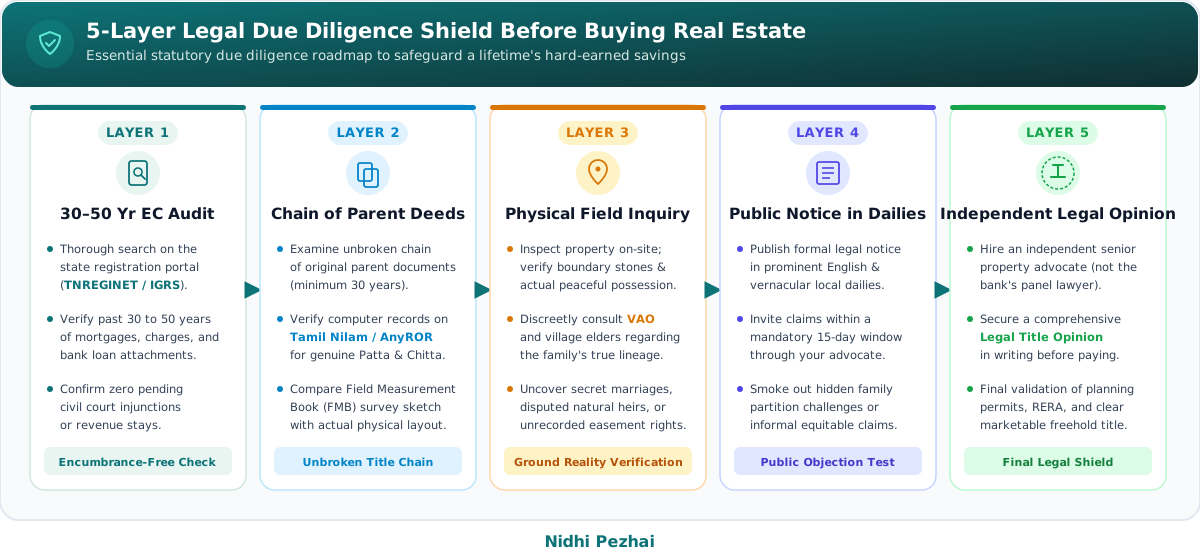
2. Commission Independent Legal Due Diligence5-Layer Scrutiny
Hire an independent property advocate with decades of local litigation experience rather than relying on bank panel opinions:
30- to 50-Year Encumbrance Certificate (EC): Search registrations across 30–50 years via state registration portals (e.g., TNREGINET).
Unbroken Chain of Parent Deeds: Trace root ownership chronologically without gaps.
Builder Project Loan NOC & Registered Release Deed: Ensure the developer has secured an individual release deed registered with the SRO for your unit.
CMDA / DTCP Completion Certificate (CC): Verify genuine planning compliance certificates on municipal portals.
Physical Field Inquiries: Visit the site in person. Speak with village administrative officers (VAO), neighbors, and local elders to uncover unrecorded family disputes or undisclosed heirs.
Newspaper Public Notice: Publish a public notice in leading English and vernacular newspapers inviting objections within 15 days before executing agreements.
3. Understand the Inherent Limits of Legal ScrutinyScrutiny Limits
Even the finest lawyer can only review registered instruments and public court indices. Runaway heirs, unrecorded bigamous marriages, or secret out-of-state Wills cannot be unearthed by standard legal checks.
4. Never Lock Up 100% of Your Net Worth in a Single Property!Concentration Risk
A hazardous financial mistake in India is liquidating all savings, mutual funds, EPF balances, and family gold, coupled with 20 years of suffocating home loan debt, to concentrate 100% of your net worth in a single property. If title defects emerge, your entire household faces financial ruin.
The unresolvable multi-generational encumbrance risks of real estate do not exist in equity index funds, mutual funds, or sovereign debt!
Diversify your wealth across highly liquid, encumbrance-free financial instruments (Equities, Debt, Gold).
If you desire exposure to commercial real estate, consider regulated Real Estate Investment Trusts (REITs) that deliver rental yields without title headaches.
Key Takeaway: "Equity investments are subject to market risks. Real estate investments are subject to market risks, plus countless legal, administrative, succession, and hidden encumbrance risks!"
1. If an Encumbrance Certificate (EC) is completely clear, does it guarantee 100% clear title?
Answer: No. An Encumbrance Certificate only reflects transactions registered at that specific Sub-Registrar's Office. Unregistered family partition deeds, pending civil lawsuits, oral agreements, statutory land ceiling violations, and Wills registered in other jurisdictions will never appear on an EC.
2. If the Patta is transferred to my name, am I the absolute owner?
Answer: No. A Patta is an administrative revenue record issued solely for land revenue/tax collection purposes; it is not a document of title. Real statutory heirs can challenge a fraudulent or erroneous Patta in civil court and reclaim their rightful inheritance.
3. Does long-term continuous physical possession confer ownership?
Answer: While the legal doctrine of Adverse Possession exists, permissive possession (such as tenancy, caretaking, or family occupation) does not confer adverse ownership. Furthermore, adverse possession cannot be claimed against the property of minors or persons of unsound mind.
Conclusion: Awareness is the Core of Prudent Investing
Land and housing may offer an emotional sense of identity; however, uncalculated land obsession can sink your life's earnings into intractable court battles.
Rather than relying on old adages, recognize the realities of modern property law and multi-generational encumbrances. Protect your family's future through diligent independent legal verification and sensible asset allocation across financial assets.
Disclaimer:
This article is published solely for educational awareness and does not constitute formal legal counsel or investment advisory. Real estate title, surveying, and succession laws vary across Indian states. Always consult an experienced property advocate before executing real estate transactions.