Throughout our lives, we work tirelessly to save and invest every hard-earned rupee—purchasing land, constructing homes, accumulating gold, maintaining fixed deposits, and building equity portfolios. We do all this to guarantee the future security and well-being of the families we cherish. Yet, a painful reality unfolds across thousands of Indian households: following the demise of the breadwinner or family elder, bitter disputes, fractured relationships, and decades-long court battles erupt among blood relatives over property partition.
Over 60% of all civil cases languishing across multiple generations in Indian courts are family property partition suits! The fundamental root cause is shockingly simple: most individuals never draft a clear, legally sound Will during their lifetime specifying how their wealth should be distributed.
Myths such as "talking about death is inauspicious", "I am too young to write a Will", or "my children will never quarrel over money" consistently delay succession planning. To ensure lasting peace, harmony, and dignity for your loved ones after your time, executing a Will is the single most vital financial and legal responsibility you owe to your family.

What is Estate Planning vs. Succession Planning?
While many people treat these two terms interchangeably, there is a fundamental conceptual distinction:
-
Estate Planning:
This is the broad umbrella framework. It encompasses the comprehensive management, protection, and disposition of your physical, financial, and digital assets both during your lifetime and after your death. Key instruments include a Will, Private Family Trusts, Power of Attorney (POA), Living Wills / Advance Medical Directives, and asset nominations.
-
Succession Planning:
This is a core pillar within estate planning. It specifically focuses on legally designating how the ownership, administrative control, and title of your assets transition to beneficiaries after your demise.
Crucial Clarification:
Estate planning is not an exclusive luxury reserved for billionaires or corporate titans. Any middle-class individual with a bank account, a two-wheeler, a term insurance policy, or a residential flat must have an estate plan to protect their dependents from bureaucratic paralysis.
The Indispensable Importance of Writing a Will
A Will (or Testamentary Declaration) is a formal legal instrument in which a person of sound mind declares how their self-acquired assets and estate should be distributed among chosen beneficiaries after their death.
1. The Perils of Intestate Succession (Dying Without a Will)
- If you die without a Will (intestate), your assets will not be distributed according to your personal wishes. Instead, they will be carved up strictly based on the statutory personal inheritance laws applicable to your religion.
- For instance, you might assume that your residential home will automatically pass entirely to your surviving spouse. However, under statutory succession laws, the property is split equally among all legal heirs—including your spouse, surviving mother, and children.
- Consequently, selling, mortgaging, or modifying the property requires the consent and physical signatures of every single legal heir. If even one heir objects or delays, the entire family faces an asset freeze.
2. Preserving Family Harmony and Preventing Litigation
A clearly drafted Will eliminates ambiguity and prevents bitter oral disputes such as "father promised me this plot" or "mother wanted me to have these jewels". It snuffs out sibling rivalries and spares your family from decades of emotionally draining court litigation.
3. Protecting Minor Children and Special Needs Dependents
If both parents suffer a fatal accident, disputes may arise among relatives regarding child custody and asset stewardship. By nominating a Testamentary Guardian for Minors in your Will, you ensure your children grow up under the care of trusted guardians without painful guardianship litigation in court. For parents of children with special needs, establishing a Will and a dedicated Private Trust is an indispensable moral imperative.
4. Bequeathing Assets to Non-Relatives, Caregivers, or Charities
If you wish to leave financial support for a trusted friend, a devoted caregiver, an animal shelter, or an educational charity, this can only be achieved through a Will. Under intestate statutory law, the entire estate is strictly funneled exclusively to statutory blood relatives.
Nominee vs. Legal Heir vs. Executor: A Vital Distinction
The single most widespread misconception in Indian personal finance is: "I have appointed my spouse as nominee across all my bank accounts, shares, and mutual funds; therefore, everything belongs to them." This is legally false. Understanding the exact differences is critical:
| Dimension |
Nominee |
Legal Heir |
Executor |
| Role & Authority |
A temporary Trustee / Caretaker only. |
The true Beneficial Owner of the estate. |
The Administrator tasked with executing the Will's instructions. |
| Asset Ownership |
Does not acquire beneficial ownership; their sole duty is to receive funds and hand them to rightful heirs. |
Possesses permanent ownership rights under statutory succession law or a valid Will. |
Cannot claim estate assets (unless explicitly named as a beneficiary in the Will). |
| Legal Standing |
Facilitator for financial institutions to discharge liabilities. |
Establishes title via Legal Heir Certificate, Succession Certificate, or Will. |
Legally empowered to obtain court Probate and distribute assets. |
| Supreme Court Rulings |
Confirmed in Sarbati Devi (1984) & Shakti Yezdani (2023): Nominees hold no ownership rights. |
Possesses absolute legal entitlement to inherited shares. |
Legally liable for honoring the testator's declared wishes. |
Supreme Court Confirmation:
In its landmark 2023 ruling (Shakti Yezdani v. Jayanand Jayant Salgaonkar), the Supreme Court of India reaffirmed that a nominee appointed in company share certificates and demat accounts is merely a custodian authorized to receive the assets from depository participants; nomination does not override the statutory laws of succession or a valid Will. Beneficial title vests solely in the legal heirs or named legatees.
The Unique Exception: Beneficial Nominee in Life Insurance (Insurance Act Sec 39)
While nominees across bank accounts, mutual funds, demat accounts, and EPF are strictly trustees, life insurance policies carry a major statutory exception introduced via the Insurance Laws (Amendment) Act, 2015:
- Insurance Act 1938 Section 39 (Beneficial Nominee):
Under this amendment, if an individual designates their spouse, parents, or children as nominees in a life/term insurance policy, they automatically attain the status of "Beneficial Nominees". They hold absolute ownership of the death benefit claim proceeds, and other legal heirs cannot claim a share.
- Married Women's Property Act 1874 (Section 6 Ring-Fencing):
Entrepreneurs, business owners, and individuals with substantial commercial debt should endorse their term insurance policies under Section 6 of the MWP Act in favor of their wife and/or children. By doing so, the policy proceeds become an untouchable trust that cannot be attached by business creditors, court decrees, the Debt Recovery Tribunal (DRT), or even the Income Tax Department.
- Post-Marriage Nomination Updates:
Employees often list their parents as nominees when joining their first job (EPF, PPF, NPS, demat, and salary accounts). After marriage, failing to update nominations to include the spouse can create devastating liquidity freezes during sudden bereavement.
- Complete Nominee Contact Details & RBI UDGAM:
Always record full nominee details—including date of birth, relationship, email, mobile number, PAN, and bank account credentials—with every financial institution. This prevents funds from turning into unclaimed deposits and getting shifted to the RBI UDGAM Portal.
To review and audit your family's nominations and estate readiness, use our 35-Point Estate Planning & Will Checklist.
Succession Laws in India Across Different Religions
In the absence of a Uniform Civil Code (UCC), intestate succession in India is governed by faith-based personal statutory laws:
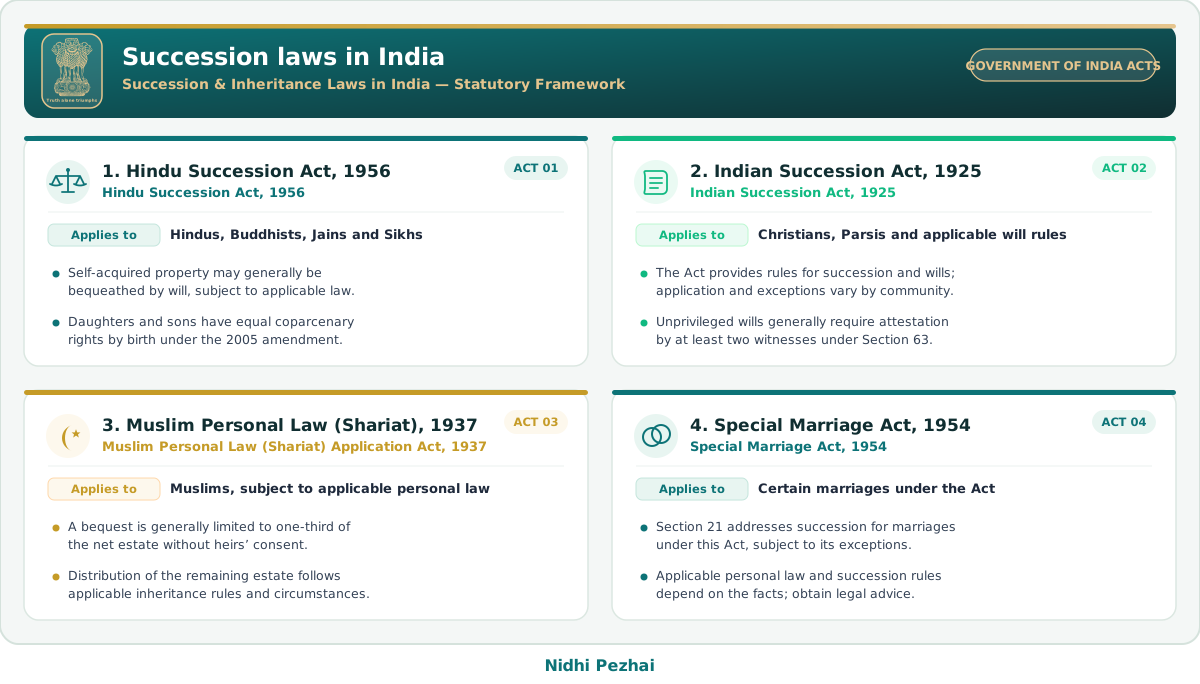
1. Hindu Succession Act, 1956 (HSA)
Hindus / Buddhists / Jains / Sikhs
- Applicability: Applies to Hindus, Buddhists, Jains, and Sikhs.
- Property Classification:
- Self-Acquired Property: Wealth purchased from your own earnings or received via an absolute gift/will. You hold 100% testamentary freedom to bequeath this property to anyone of your choice through a Will.
- Ancestral Property: Property inherited undivided through four generations. A testator can only bequeath their specific undivided coparcenary share via a Will.
- 2005 Amendment Act: Daughters are granted equal coparcenary birthrights in ancestral property on par with sons.
- Intestate Succession: If no Will exists, self-acquired property is partitioned equally among Class-I heirs (mother, surviving widow, sons, and daughters).
- Official Central Statute: Hindu Succession Act, 1956 (indiacode.nic.in)
2. Indian Succession Act, 1925 (ISA)
Christians / Parsis / Universal Will Rules
- Applicability: Governs intestate succession for Christians and Parsis. Crucially, Part VI of this Act serves as the foundational legal framework governing the drafting, execution, attestation, and probate of all testamentary Wills across India (regardless of religion, with specific exceptions for Muslims).
- Key Provisions:
- The testator must be at least 18 years of age and of sound mind (Section 59).
- The Will must be attested by at least two competent witnesses in the physical presence of the testator (Section 63).
- In Christian intestate succession, one-third (1/3rd) of the estate goes to the widow, and the remaining two-thirds (2/3rds) are distributed equally among children.
- Official Central Statute: Indian Succession Act, 1925 (indiacode.nic.in)
3. Muslim Personal Law (Shariat) Application Act, 1937
Shariat / 1/3rd Estate Ceiling
- Applicability: Applies to Indian Muslims regarding inheritance and estate administration.
- Key Testamentary Restrictions on a Will (Wasiyat):
- A Muslim can bequeath a maximum of one-third (1/3rd) of their net estate via a Will to outsiders or non-heirs.
- The remaining two-thirds (2/3rds) must strictly follow Quranic and Shariat succession rules among statutory legal heirs.
- Bequeathing any part of the 1/3rd share in favor of an existing legal heir is invalid unless all other legal heirs provide their explicit consent after the testator's death.
- Official Central Statute: Muslim Personal Law (Shariat) Application Act, 1937 (indiacode.nic.in)
4. Special Marriage Act, 1954 (SMA)
Inter-faith Civil Marriages
Step-by-Step Guide to Drafting a Will
Drafting a Will is straightforward. You can write it by hand or type it on plain paper by following this structured six-step sequence:
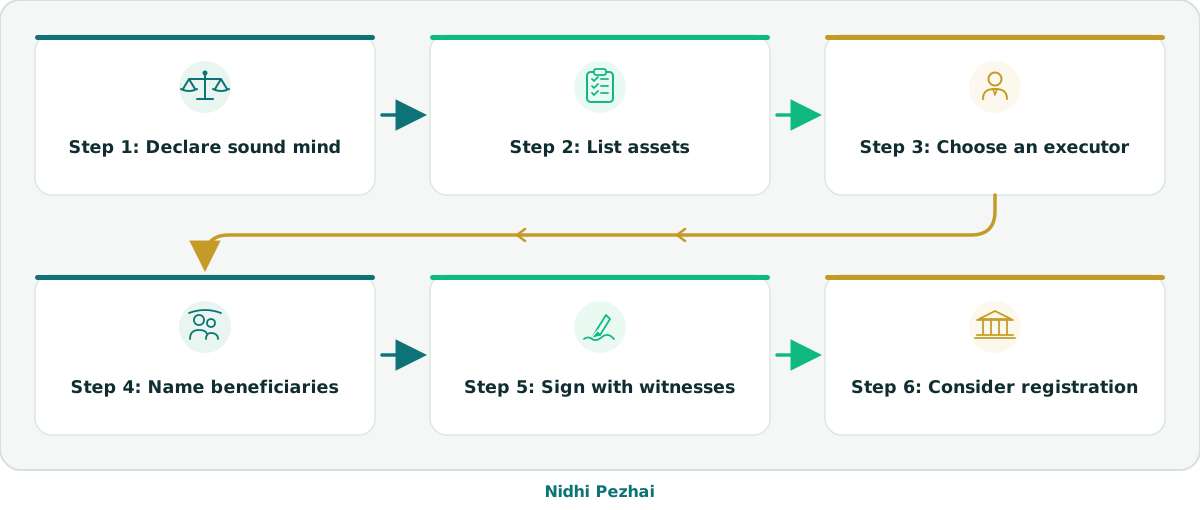
Step 1: Declaration of Sound Mind & Voluntary Intent
Mental Capacity Certificate
Begin by stating your full name, age, father's/husband's name, and residential address, followed by an explicit statement: "I declare that I am executing this Last Will and Testament in sound mental health, in full possession of my faculties, and acting voluntarily without any coercion, fraud, or undue influence."
For testators aged 60 and above, obtaining a fitness certificate from a registered medical practitioner (MBBS/MD) certifying sound mental capacity on the date of execution is best practice. Attaching this medical fitness certificate preempts post-death challenges alleging cognitive decline or senility.
Step 2: Comprehensive Asset & Liability Inventory
Physical & Digital Assets
Catalog all movable and immovable assets with unambiguous precision:
- Immovable Properties: Complete property addresses, survey numbers, plot/door numbers, registered document numbers, and Sub-Registrar Office jurisdiction.
- Traditional Financial Assets: Bank account numbers, FD receipt IDs, demat account numbers, mutual fund folios, EPF/PPF accounts, and vehicle registration numbers.
- Modern Digital Assets & Royalties: Clearly define rights for monetized YouTube channels, social media accounts, intellectual property/patents, publishing/music royalties, website domains, and cryptocurrency private key cold storage. Configure legacy features such as Google Inactive Account Manager and Apple Legacy Contact.
- Primary Mobile SIM & 2FA Responsibility: Accessing critical OTPs for banking, mutual funds, and emails requires access to the primary mobile SIM. Designate a trusted family member to maintain ownership and connectivity of your primary phone number.
- Hallmarked Gold Jewellery Inventory: Avoid vague descriptions like "family gold". Specify gross/net weights, 916 hallmarking details, purchase receipts, and safe locker numbers.
- Utilize our In Case of Emergency (ICE) Kit Checklist to assemble all account numbers in an organized format.
Step 3: Appointing an Executor
Executor Selection
Appoint a reliable, trusted, and neutral individual as the Executor of your Will. The Executor is legally empowered to represent your estate, petition for court Probate (where required), collect assets, discharge liabilities, and distribute remaining wealth to legatees. You should also nominate an Alternate Executor in case the primary executor predeceases you or is unable to act.
Step 4: Beneficiaries & Allocation
Clear Distribution
Clearly define who receives each asset, expressed either as specific bequests or exact percentages. Incorporate a Contingency Clause specifying who inherits a share if a named beneficiary predeceases you.
- Documenting Reasons for Unequal Shares: If dividing assets unequally among children or excluding a natural legal heir, document the rationale directly in the Will (e.g., significant funds already provided for a specific child's education or marriage, or recognizing a child who provided devoted care during old age). This deters future court challenges alleging coercion or undue influence.
Step 5: Appointing a Guardian for Minor Children
Minor Guardianship
If you have children under 18 years of age, nominate a legal guardian to oversee their upbringing, health, and education. Specify that the children's inherited funds be held in trust and managed by the guardian solely for their benefit until they attain legal majority (or age 21/25).
Step 6: Attestation by Neutral Witnesses
Witness Protocol
Under Section 63 of the Indian Succession Act, you must sign the Will in the physical presence of at least two independent attesting witnesses, who must then sign in your presence and in the presence of each other.
- The Golden Rule: Beneficiaries (and their spouses) must NEVER act as attesting witnesses! Under Indian law, an attestation by a beneficiary renders their bequest void.
- Appoint Witnesses 15-20 Years Younger: Avoid selecting peers of similar age. Choose credible witnesses who are 15 to 20 years younger and in good health, ensuring they will likely be alive to testify during probate proceedings or sub-registrar verifications.
- 3 to 4 Witnesses Recommended: While the law mandates a minimum of 2 witnesses, having 3 or 4 credible, non-beneficiary witnesses provides an unshakeable legal defense.
9 Best Practices When Writing a Will
To eliminate legal vulnerabilities, ambiguities, or family disputes, incorporate these nine proven best practices:
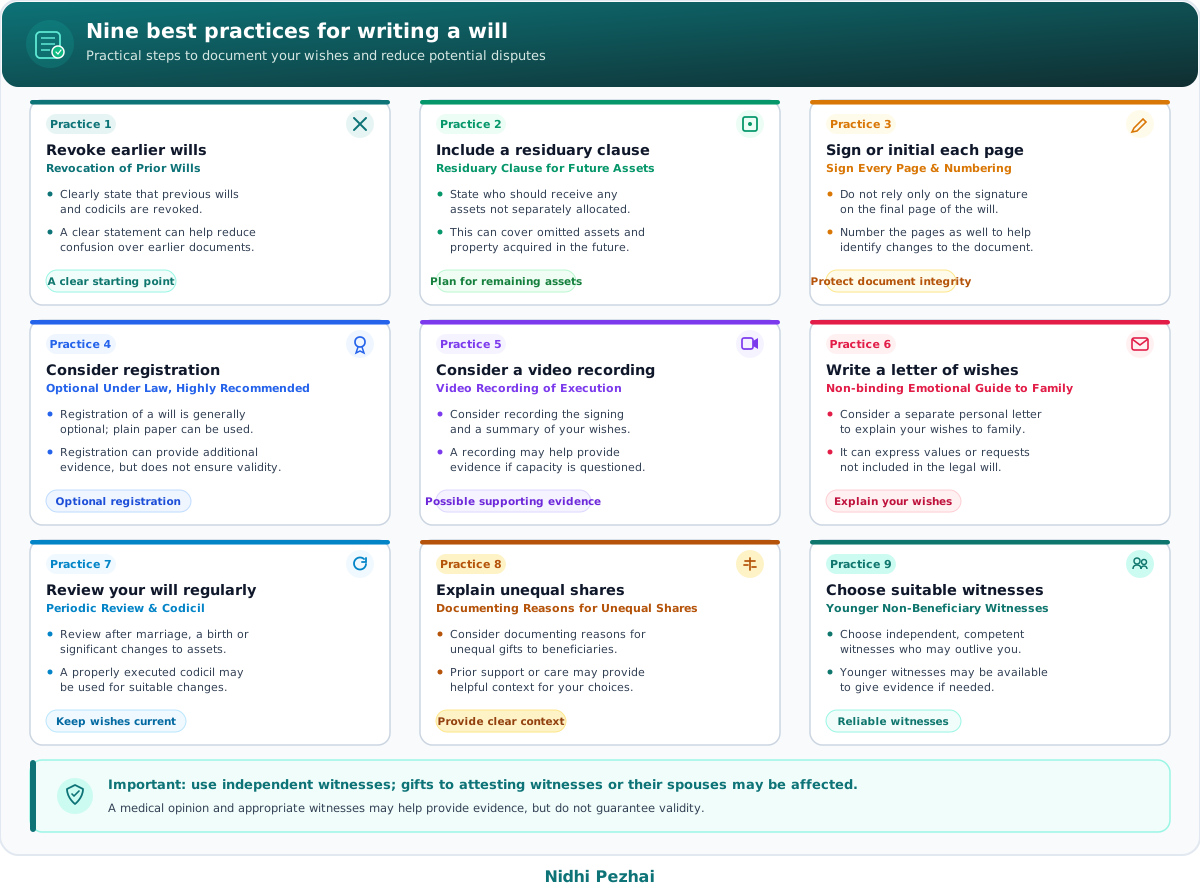
1. Revocation of Prior Wills Clause
Revoke Prior Wills
Include a clear revocation statement in the very first paragraph: "I hereby revoke all prior Wills, codicils, and testamentary dispositions made by me, whether oral or written."
- Legal Principle: A person can rewrite their Will as many times as they wish during their lifetime; only the final validly executed Will holds legal authority.
- Practical Benefit: Explicitly revoking earlier versions prevents estranged relatives from presenting outdated drafts in court.
2. Residuary Clause
Future Asset Protection
A Residuary Clause serves as a safety net for any asset acquired after the Will is executed, or inadvertently omitted:
- Sample Text: "All the rest, residue, and remainder of my estate, both movable and immovable, of whatsoever nature and wheresoever situated, not otherwise effectively disposed of, shall devolve upon my spouse / child."
- Practical Benefit: Avoids the need to execute a new Will every time you open a bank account or make a new investment.
3. Sign Every Page & Number Sequentially
Fraud Prevention
Never sign only on the final execution page. The testator and witnesses should sign or initial at the bottom of every single page:
- Page Numbering: Clearly format pages sequentially (e.g., "Page 1 of 4", "Page 2 of 4").
- Practical Benefit: Completely invalidates post-death allegations of fraudulent page substitution, tampering, or interlineation.
4. Is Registration Mandatory?
Optional Registration
Under Section 18 of the Registration Act, 1908, registering a Will is completely optional (not legally mandatory).
- Legal Standing: A Will executed on plain paper and signed before two witnesses is 100% legally valid. No expensive stamp paper is required.
- Why Registration is Recommended: Registering the Will at the Sub-Registrar's Office (SRO) provides substantial evidentiary weight. The Registrar verifies identity and mental capacity, making it exceptionally difficult for disgruntled parties to claim forgery or fabrication.
5. Video Recording of Execution
Digital Evidence
Recording a brief video of the execution ceremony on a smartphone has become modern best practice:
- What to Record: The testator reading a brief summary of their declarations, signing the document in the presence of witnesses, and the witnesses signing in the testator's presence.
- Legal Strength: Serves as admissible electronic evidence (under the Bharatiya Sakshya Adhiniyam, 2023) to dismantle bad-faith allegations of lack of testamentary capacity or undue influence.
6. Letter of Wishes
Family Guidance
Accompany your Will with a personal Letter of Wishes addressed to your family:
- Characteristics: It is a non-binding moral document. You can express personal guidance, emotional requests, philanthropic values, and funeral preferences.
- Purpose: Helps prevent misunderstandings and encourages family members to maintain unity and mutual respect during property transitions.
7. Periodic Updates & Codicils
Periodic Review
Review and update your Will following major life events:
- Triggers for Revision: Marriage, divorce, birth or adoption of children, substantial acquisition or sale of property, or the demise of a named executor, guardian, or witness.
- Codicil vs. New Will: Minor adjustments (e.g., an address change or updating an account number) can be accomplished via a Codicil (a supplementary amendment). For significant structural distribution changes, drafting a fresh Will that revokes all earlier versions is cleaner and safer.
8. Documenting Reasons for Unequal Distribution
Dispute Prevention
When allocating disparate shares or excluding a natural heir, explicitly explain the underlying rationale:
- Context to Highlight: Acknowledge past financial support provided to a specific child (e.g., overseas education, business seed capital, or extravagant wedding expenses), or commend another child who provided dedicated, full-time caregiving during senior years.
- Legal Shield: Neutralizes claims that the testator was coerced, manipulated, or deceived by the primary beneficiary.
9. Selecting Witnesses 15-20 Years Younger
Witness Longevity
Rather than appointing elderly peers as attesting witnesses, select reliable, neutral individuals who are 15 to 20 years younger:
- Evidentiary Need: Following the testator's demise, at least one attesting witness must be alive and mentally competent to swear an affidavit in court during probate proceedings or sub-registrar inquiries.
- Reminder: Appointing 3 to 4 younger witnesses provides layered redundancy, but never allow beneficiaries to witness the Will.
Comprehensive Estate Planning: 6 Essential Shields Beyond a Will
Many assume that executing a Will completes their estate planning. This is an oversight. A Will takes effect only upon death.
If an individual suffers a severe stroke, dementia, Alzheimer's, or enters a coma during their lifetime, a Will is completely dormant. Who manages finances, collects rents, pays medical bills, or makes emergency healthcare decisions? To protect family wealth throughout your lifetime and across generations, these six legal safeguards are essential:
1. General Power of Attorney (GPA / Durable POA)
Lifetime Asset Management
If prolonged illness, overseas relocation (NRI), or aging limits your ability to manage affairs, executing a registered General Power of Attorney in favor of a trusted spouse or adult child ensures seamless operations—such as collecting rents, maintaining properties, paying taxes, operating bank accounts, and funding medical emergencies.
2. Living Will / Advance Medical Directive & Healthcare Proxy
Dignity in Dying & Healthcare
Under landmark Supreme Court directives on passive euthanasia, a Living Will (Advance Medical Directive) allows you to formally declare that in the event of terminal illness or irreversible coma, invasive life-support systems (ventilators) should not be used to prolong bodily suffering unnecessarily.
- Designate a trusted family member as your Healthcare Proxy to make medical decisions when you cannot communicate.
- Execute the document before a Judicial Magistrate of First Class (JMFC) or designated municipal registrar and furnish copies to family and attending physicians.
3. Private Family Trust (Indian Trusts Act, 1882)
Family Trust Structure
For families with substantial wealth or unique personal circumstances, establishing a Private Family Trust offers protections that surpass a simple Will:
- Spendthrift Protection: If heirs lack financial maturity, the trust can hold capital intact until beneficiaries reach age 35 or 40, disbursing controlled monthly stipends for living expenses.
- Divorce & Creditor Protection: Shields daughters' inheritances from being lost in marital divorce disputes or attached by business creditors and bankruptcy proceedings.
- Special Needs Child Trust: Under the National Trust Act, 1999, setting up a dedicated trust ensures lifelong financial support, shelter, healthcare, and institutional guardianship for children with developmental or intellectual disabilities after parents pass away.
4. Never Gift Away Assets During Your Lifetime!
Senior Citizen Warning
A tragic mistake made by many elderly parents in India is transferring their self-acquired homes or savings to their children through an unconditional Gift Deed / Settlement Deed during their lifetime, only to be neglected, mistreated, or evicted.
- The Golden Rule: Retain complete, unencumbered ownership of your assets throughout your lifetime. Transfer them only upon your death via a Will.
- Senior Citizens Act, 2007 (Section 23): Under the Maintenance and Welfare of Parents and Senior Citizens Act, 2007, if a senior citizen transfers property subject to the condition that the transferee provides basic amenities and physical needs, and the child subsequently neglects them, the Revenue Divisional Officer (RDO) Tribunal has statutory power to declare the gift deed void and restore the property to the parent.
5. Land Records & Title Due Diligence (e.g., Tamil Nadu Records)
Title Verification
Before referencing land or residential properties in a Will, verify that government land records reflect clear, marketable title:
- E-Patta & Chitta (e.g., Tamil Nilam): Verify on state portals such as Tamil Nilam (eservices.tn.gov.in) that computerised Pattas, Chitta extracts, and FMB sketches are registered accurately in your name with proper sub-division numbers.
- 30-Year Encumbrance Certificate (EC): Download a 30-year EC (e.g., via TNREGINET) to confirm no unresolved mortgages, attachments, or litigation clouds exist on title.
- Chain of Parent Deeds: Maintain an unbroken chain of registered title deeds and file them securely with your In Case of Emergency (ICE) Kit.
6. Never Sign Relinquishment Deeds in Bereavement Haste!
Release Deed Warning
In the immediate emotional shock following the death of a family patriarch, distant relatives or coparceners may urge surviving widows or daughters to execute a Relinquishment Deed (Release Deed) or Power of Attorney under the pretext of "simplifying tax or municipal paperwork". Surviving heirs should never sign any document without independent legal counsel from a trusted family lawyer.
In modern India, reputable legal-tech platforms allow individuals to draft legally sound Wills from home at accessible price points:
| Platform |
Website |
Key Features |
Best Suited For |
| WillJini |
willjini.com |
Pioneer in Indian Will drafting. Offers DIY online templates, lawyer consultations, and doorstep registration support. |
Individuals, salaried employees, and business owners with straightforward assets. |
| Yellow |
getyellow.in |
Modern estate planning fintech app. Secure digital vault and intuitive mobile-guided Will creation. |
Tech-savvy professionals and young families. |
| LawRato |
lawrato.com |
Leading legal discovery portal. Connects clients with vetted local family and property lawyers across Indian cities. |
Complex estates, disputed properties, and multi-state assets. |
| Clear (ClearTax) |
cleartax.in |
Online Will drafting backed by legal and taxation experts. |
Salaried investors and corporate executives. |
| Bank & Brokerage Tie-ups |
HDFC Securities, ICICI Securities |
Major brokerages offer integrated E-Will services in partnership with corporate trust firms. |
Active demat and trading account holders. |
Service Providers Disclaimer:
The service providers listed above are presented strictly for informational and educational awareness; this is not an exhaustive list. Our publication does not endorse or recommend any specific commercial entity, nor do we maintain any commercial affiliation with them. Readers should independently evaluate terms, security protocols, and credentials before engaging any provider. Our publication assumes no liability for legal complications, financial losses, or service deficiencies resulting from the use of these third-party platforms.
Online Will vs. Traditional Legal Counsel: Which Should You Choose?
- Online Platforms: If your estate is clean and straightforward (e.g., self-acquired apartment, mutual funds, EPF, FDs) and family dynamics are peaceful, online legal-tech platforms provide an economical (₹1,500 – ₹5,000) and convenient solution.
- Traditional Senior Legal Counsel: If your estate involves undivided ancestral properties, active business partnerships, cross-border NRI assets, or complex family relationships, engaging an experienced estate lawyer in person is strongly advised.
Frequently Asked Questions (FAQs)
1. Is Stamp Paper required to write a Will?
Answer: No. Indian law does not require a Will to be written on stamp paper. A Will handwritten or typed on plain paper and signed in the presence of two witnesses is 100% legally enforceable.
2. Is a handwritten Will (Holograph Will) legally valid in India?
Answer: Yes, entirely valid. A Will written completely in the testator's own handwriting is known legally as a Holograph Will. Provided it is signed and attested by two witnesses, courts accord it full validity.
3. What is Probate, and is it mandatory across India?
Answer: Probate is a certificate issued by a competent civil court certifying the genuineness and validity of a Will, empowering the Executor to administer the estate. Under Sections 57 and 213 of the Indian Succession Act, Probate is mandatory only for Wills executed by Hindus, Buddhists, Jains, or Sikhs within the historical presidency towns of Chennai, Mumbai, and Kolkata, or where immovable property covered by the Will is situated within these metropolitan limits. For the rest of India, Probate is optional unless specifically directed by a court.
4. How many times can a Will be revised?
Answer: You can modify, amend, or revoke your Will as many times as you desire during your lifetime. The last validly executed Will (Last Will and Testament) supersedes all earlier iterations.
5. Where should a Will be safely stored?
Answer: Store the original Will in a bank locker or deposit it with your trusted legal counsel. Place a copy in your physical In Case of Emergency (ICE) Kit and encrypted digital vault. Ensure your appointed Executor and spouse know its exact location and retrieval procedure.
Related Guides & Calculators
Official Statutory Links
- Indian Succession Act, 1925 (India Code)
- Hindu Succession Act, 1956 (India Code)
- Muslim Personal Law (Shariat) Application Act, 1937 (India Code)
- Special Marriage Act, 1954 (India Code)
- Registration Act, 1908 (India Code)
- Insurance Act, 1938 (Section 39 Beneficial Nominee) (India Code)
- Maintenance and Welfare of Parents and Senior Citizens Act, 2007 (India Code)
- Indian Trusts Act, 1882 (India Code)
- Married Women's Property Act, 1874 (Section 6) (India Code)
- Ministry of Law and Justice, Government of India
Conclusion: A Legal Testament of Love
Accumulating wealth is only half of financial responsibility; ensuring that your hard-earned assets transition smoothly, preserving harmony and affection among your heirs, is the true test of life planning. A Will is not merely a legal document—it is a covenant of peace, security, and dignity that shields your family when they need it most.
Do not postpone this vital duty. Have an open conversation with your loved ones and draft your Will today.
Disclaimer:
This article is published exclusively for educational and legal awareness purposes and does not constitute formal legal counsel or financial advisory. Succession and estate laws vary according to personal circumstances, faith, and state jurisdiction. Consult a qualified legal practitioner or estate planning advocate to draft and execute documents tailored to your family's needs.
