
Throughout our lives, we work tirelessly to earn, save money in bank accounts, and invest across equities, mutual funds, real estate, and gold. But pause and consider for a moment: if an unexpected accident, critical medical emergency, or sudden death strikes, will our families be able to easily locate and access all the wealth, investments, and insurance protections we built over decades?
In India alone, over ₹1.5 lakh crore to ₹1.84 lakh crore in unclaimed financial assets lies trapped across banks, insurance companies, mutual funds, equities, and the Employees' Provident Fund (EPF). The primary culprit: when the breadwinner passes away or is incapacitated, their spouse or legal heirs are completely unaware of where accounts were opened, what policies existed, or how to initiate claims.
Official Sources & Regulatory Evidence:
According to official statistics tabled by the Ministry of Finance in the Indian Parliament (Lok Sabha & Rajya Sabha) and reports from the Press Information Bureau (PIB), unclaimed assets across various financial institutions in India have surpassed ₹1.8 lakh crore. To help return these funds to legitimate heirs, the Department of Financial Services (DFS) under the Ministry of Finance has launched a national awareness campaign: "Aapki Poonji, Aapka Adhikar" (Your Capital, Your Right). Key official government portals for tracking unclaimed assets include:
- Unclaimed Bank Deposits: Reserve Bank of India's (RBI) UDGAM Portal (udgam.rbi.org.in) — Unclaimed bank balances in accounts inoperative for over 10 years are transferred to the RBI Depositor Education and Awareness (DEA) Fund under Section 26A of the Banking Regulation Act (public sector banks alone account for over ₹60,000+ crore).
- Unclaimed Insurance Balances: Insurance Regulatory and Development Authority of India's (IRDAI) Bima Bharosa Portal (bimabharosa.irdai.gov.in) — Official portal for searching unpaid insurance claims, maturity proceeds, and refunds.
- Shares, Dividends & Debentures: Ministry of Corporate Affairs' (MCA) IEPF Portal (iepf.gov.in) — Investor Education and Protection Fund holds dividends and shares unclaimed for 7 consecutive years.
- Unified Financial Asset Search: The central search gateway setup by the Department of Financial Services (DFS) at unclaimedassetsportal.in.
To avoid leaving your family in such distress, an In Case of Emergency (ICE) Kit or Financial Dossier serves as a guiding lighthouse during difficult times.
1. What is an In Case of Emergency (ICE) Kit?
An ICE Kit (In Case of Emergency Kit) or Financial Dossier is a centralized master financial repository where a family's financial assets, liabilities, insurance policies, government identity proofs, legal documents, and critical emergency contacts are systematically organized and securely stored.
It is not merely a list of numbers; it is a financial roadmap designed to guide your family when the primary decision-maker is unable to make choices due to accident, illness, or death.
Who Needs This?
- Married Couples: Ensures seamless continuation of household financial management if one partner is unavailable.
- Individuals with Aging Parents: Provides immediate access to parents' health insurance, pension, and medical history.
- Sole Breadwinners: Protects dependent families from immediate liquidity freezes or administrative paralysis.
- Active Investors: Consolidates diversified holdings spread across stock brokerages, mutual funds, EPF, NPS, real estate, and gold.
2. Two-Tier Approach to Your ICE Kit (Physical & Digital)
A robust financial dossier should exist in two synchronized formats:
-
Physical Paper Folder (ICE Binder):
- A durable, fireproof, and waterproof document bag or zip folder.
- Contains physical photocopies of all key identity documents, a directory of where original certificates are stored, health insurance e-cards, and an emergency letter of instructions.
- Kept in a secure, accessible home location known to your spouse or trusted family member.
-
Encrypted Digital Vault:
- High-resolution scanned PDF copies of all essential documents.
- A password-protected, AES-256 encrypted USB drive or secure cloud storage (e.g., Google Drive, OneDrive with two-factor authentication).
- Password manager emergency access configurations (e.g., Bitwarden or 1Password Emergency Access).
Critical Security Warning:
Never write plain-text net banking passwords, ATM PINs, or credit card CVV codes in a physical notebook or loose sheet. Manage sensitive login credentials exclusively through modern, encrypted password managers (such as Bitwarden or 1Password).
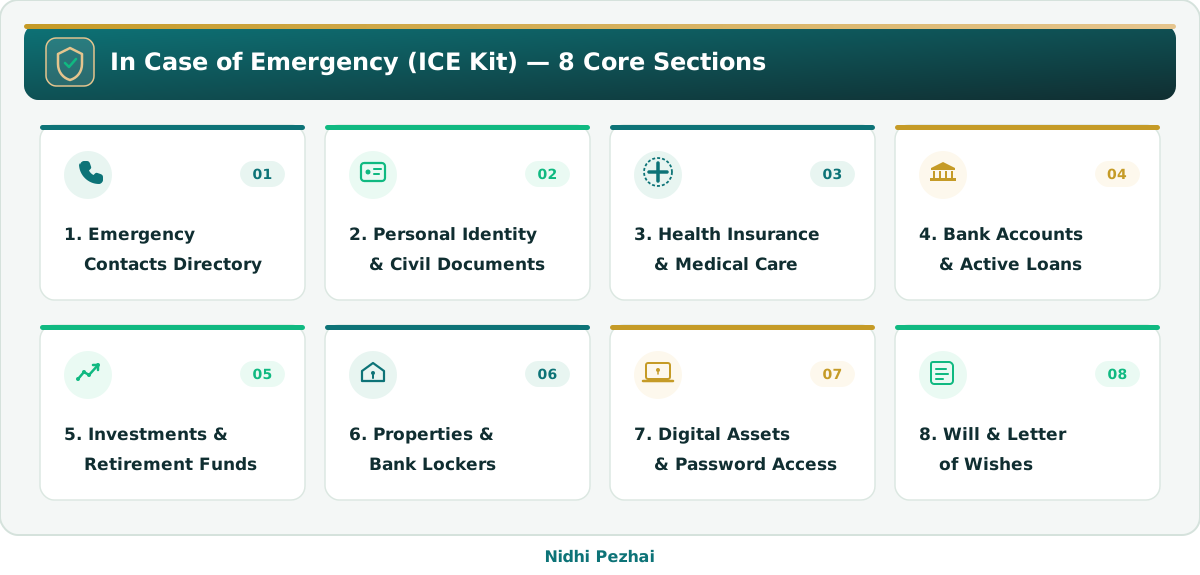
3. The 8 Core Sections of an In Case of Emergency Kit
A comprehensive family financial dossier should be systematically structured into the following eight core sections:
4. Will and Letter of Wishes
Nominee vs. Legal Heir: A Crucial Warning!
A common and dangerous misconception is: "I have named my spouse as the nominee across all my bank accounts and mutual funds, so everything automatically belongs to them."
The Legal Reality in India:
Under Indian law, a nominee is not the beneficial owner of the asset; they are merely a trustee or custodian (Fiduciary Caretaker)!
If an individual dies intestate (without a valid Will), even if the spouse is the registered nominee, personal succession laws (such as the Hindu Succession Act, Indian Succession Act, etc.) mandate equal shares among all Class-I legal heirs (mother, surviving spouse, and children). This ambiguity often leads to bitter disputes and prolonged court litigation.
The Need for a Will
- If you want your self-acquired property and investments to go exclusively to the persons you choose without ambiguity, drafting a clear Will is indispensable.
- A Will can be drafted through an advocate or written on plain paper, signed in the presence of two independent witnesses (registering the Will provides additional evidentiary strength).
- Note the location of the original Will and the appointed Executor in your ICE Kit.
- Read our comprehensive guide on Will drafting, succession laws, and procedures here.
Letter of Wishes
A Letter of Wishes is not a formal legal document; rather, it is an informal, heartfelt guidance memo to your family outlining practical priorities:
- "If life insurance proceeds are received, prioritize clearing the home loan first."
- "Do not liquidate equity mutual funds allocated for children's higher education unless absolutely necessary."
- "Trusted financial professionals to consult, and individuals or schemes to strictly avoid borrowing from or investing in."
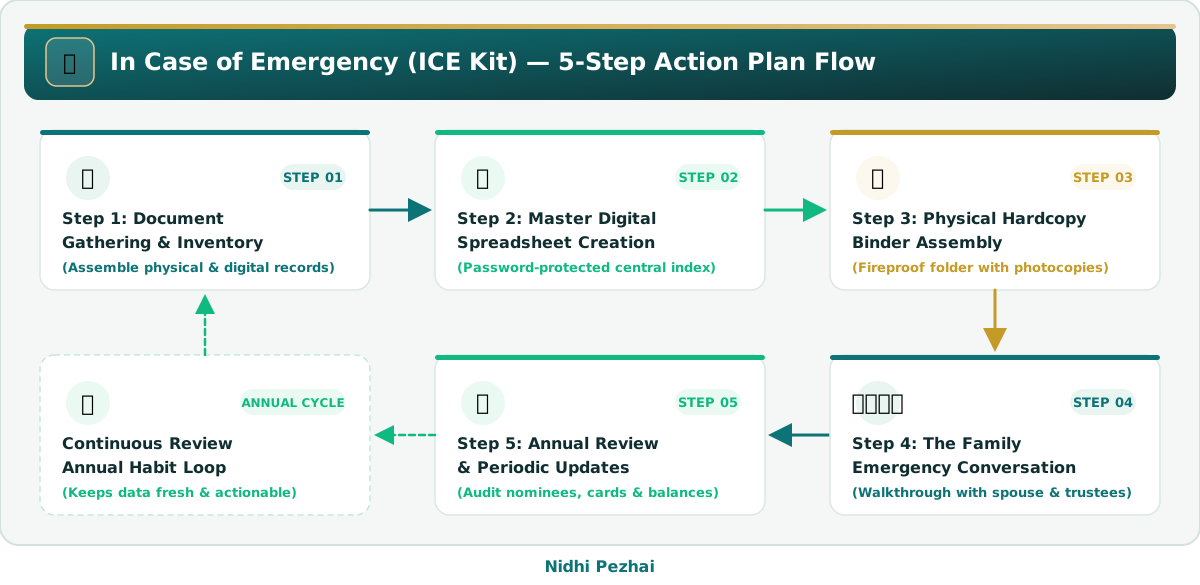
5. 5-Step Action Plan to Build Your ICE Kit
You can assemble a complete family emergency financial dossier over a single weekend by following these five structured steps:
6. Interactive In Case of Emergency (ICE) Kit Checklist
To evaluate your family's financial preparedness and verify that no critical item has been overlooked, use our interactive checklist tool:
- Live Preparedness Progress Tracking: Instantly calculates your family's financial security score as you check off items.
- 8 Core Sections & 36 Checkpoints: Detailed checkpoints spanning emergency contacts, civil documents, health insurance, banking, investments, real estate, digital legacy, and estate planning.
- Free Excel (.xlsx) Download: Download your customized, pre-formatted family master spreadsheet with a single click to save on your private computer.
- Print-Friendly Format: Clean styling optimized for printing and filing directly into your physical emergency binder.
Open the Interactive ICE Kit Checklist (Review 36 Checkpoints & Download Excel).
7. Frequently Asked Questions (FAQs)
Q1: Should I write down my banking passwords and ATM PINs in this physical dossier?
Answer: No, absolutely not. If the binder is misplaced, lost, or falls into the wrong hands, written credentials expose you to severe financial fraud. Train yourself to use an encrypted password manager (such as Bitwarden or 1Password) and grant your spouse emergency access through the platform's verified recovery mechanism.
Q2: Is appointing a nominee enough, or is a Will mandatory?
Answer: Appointing a nominee is not sufficient to guarantee ownership. Under Indian law, a nominee is merely a legal trustee holding assets until distributed according to succession law or a Will. If you pass away without a Will (intestate), assets must be shared among all statutory legal heirs, often resulting in complex family disputes. A valid Will is the only legally binding instrument that dictates asset distribution according to your wishes.
Q3: When should I update this emergency dossier?
Answer: Conduct an annual audit at least once a year. Additionally, update the dossier immediately whenever a major life event occurs—such as the birth of a child, purchasing property, switching employers, closing or taking out loans, or buying new insurance policies.
Q4: What if my spouse or family members have zero financial background?
Answer: Write a prominent note on the very first page of the ICE Kit listing the contact details of your Chartered Accountant (CA), SEBI Registered Investment Advisor (RIA), or trusted family mentor, with explicit instructions: "Consult this advisor before making any major financial decisions, signing papers, or liquidating investments."
Conclusion: The Ultimate Expression of Care
Compiling a family financial dossier requires just a few hours of dedicated effort over a weekend. Yet, during an unforeseen crisis, it serves as an invaluable shield that protects your grieving family from confusion, bureaucratic hassles, and severe financial losses.
"Providing for your family while you are here is your responsibility; ensuring they can live with dignity and financial security when you are not is true love."
Start compiling your family's Financial Dossier / In Case of Emergency (ICE) Kit today!
Related Guides & Calculators:
- Importance of Writing a Will: Complete Succession Planning Guide
- Interactive ICE Kit 36-Point Checklist (with Excel Download)
- Estate Planning & Will Creation Checklist for Indian Families
- Personal Finance Fortification 25-Point Comprehensive Checklist
- Family Emergency Fund Planner Calculator
- Family Protection Life Insurance Sum Assured Calculator
- Personal Finance Fortification Guide
Official Government Portals for Locating Unclaimed Assets:
- RBI UDGAM Portal (Unclaimed Bank Deposits)
- Ministry of Finance Unified Portal (Unclaimed Financial Assets)
- MCA IEPF Portal (Unclaimed Shares & Dividends)
- IRDAI Bima Bharosa (Unclaimed Insurance Proceeds & Policies)
- EPFO Unified Member Portal (Inoperative EPF Accounts)
Disclaimer:
This article is published solely for educational and general financial awareness purposes and does not constitute formal legal, taxation, or investment advisory. Consult a qualified legal professional or a SEBI Registered Investment Advisor (RIA) to address your specific estate planning and financial circumstances.