
"Consider the products and services that shape our daily lives from morning to night: the Apple iPhone in our hands, Google search, Microsoft Windows, Amazon online shopping, Instagram (Meta), Netflix streaming, and Nvidia AI chips..."
These platforms dominate our modern world. We are their enthusiastic consumers. Yet, when asked if we participate as shareholders in the massive wealth generated by their global compounding, the honest answer for most Indian investors is: "No."
The US stock market accounts for over 60% of total global stock market capitalization, whereas India represents roughly 3.5% to 4%. Restricting 100% of your wealth to Indian shores creates severe geographical concentration risk—effectively bypassing 96% of the world's wealth-creation opportunities.
"How can an Indian resident legally invest in US stocks and ETFs? What are the RBI's Liberalised Remittance Scheme (LRS) limits? How do you manage the 20% TCS threshold? What are the tax implications under Form W-8BEN and the hidden threat of the US Estate Tax? How do GIFT City IFSC and international brokers compare?"
This comprehensive guide breaks down the rules, tax mechanics, and actionable pathways to investing in global equities directly from India.

1. Why Should an Indian Investor Allocate Capital to the US and Global Markets?
While the Indian economy enjoys solid long-term growth prospects, three foundational financial principles justify international portfolio allocation:
1. Geographical Diversification:
"Never put all your eggs in one basket" is the foundational axiom of prudent investing. When your home, employment income, bank savings, PPF, and stock investments are all located in a single country and denominated in a single currency (INR), any localized political upheaval, geopolitical tension, or economic stagnation directly hits your entire net worth. Allocating a portion of your wealth internationally broadens your asset base, softens localized market shocks, and strengthens portfolio resiliency.
2. Currency Depreciation Hedge:
Historically, the Indian Rupee has depreciated against the US Dollar at an average rate of 3% to 4% annually (Source: RBI DBIE Handbook of Statistics & Federal Reserve FRED DEXINUS):
- In 2004: 1 USD = ~₹45
- In 2014: 1 USD = ~₹60
- In 2024–2026: 1 USD = ~₹83 to ₹84+
If US equities gain 10% in a given year while the Rupee depreciates by 3% against the Dollar, an Indian investor earns an effective 13%+ return in Rupee terms. For families planning overseas higher education for their children or international travel, holding dollar-denominated assets provides a vital purchasing power hedge.
3. Exposure to Non-Replicable Global Innovators:
India's equity markets are heavily weighted toward banking, financial services, IT outsourcing, FMCG, oil & gas, and domestic pharmaceuticals. However, leaders in frontier industries—such as generative AI hardware, semiconductor fabrication and design, cloud enterprise infrastructure, commercial aerospace, and global e-commerce—are listed primarily on US exchanges. Direct access to these structural tailwinds requires investing internationally.
2. The 3 Primary Routes to Invest in Foreign Equities from India
Indian resident individuals have three main avenues to gain international equity exposure:
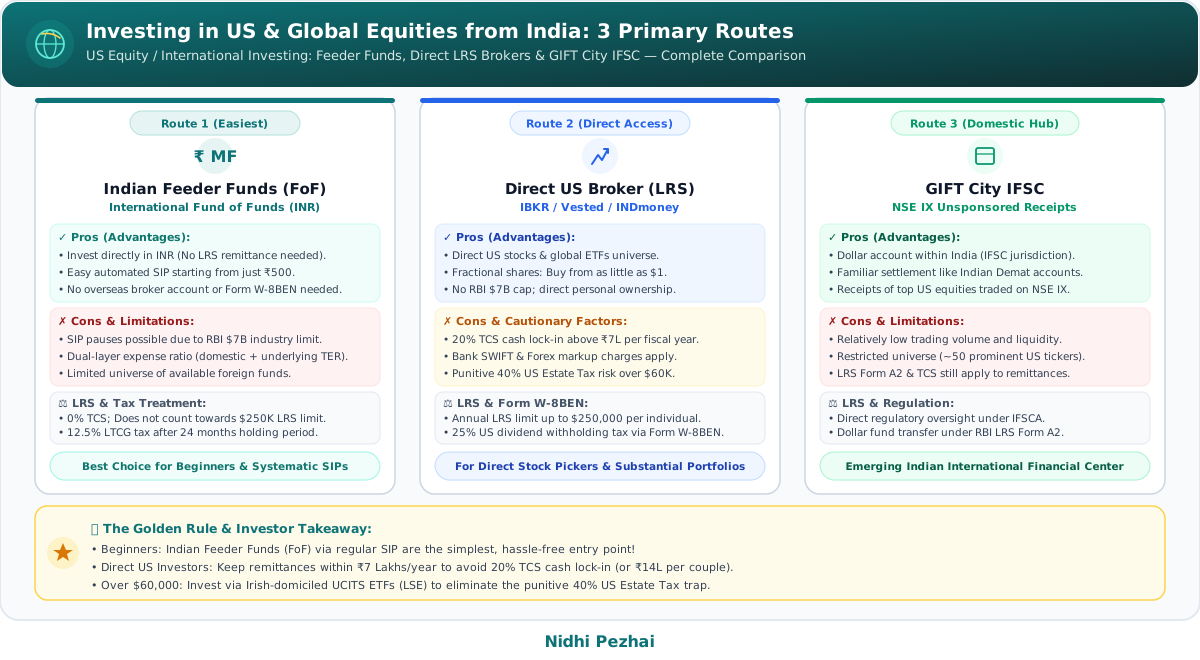
| Parameter | Route 1: Indian Feeder Funds (FoF) | Route 2: Direct US Broker (LRS) | Route 3: GIFT City IFSC (NSE IX) |
|---|---|---|---|
| Investment Currency | Indian Rupee (INR) | US Dollar (USD) | US Dollar (USD) |
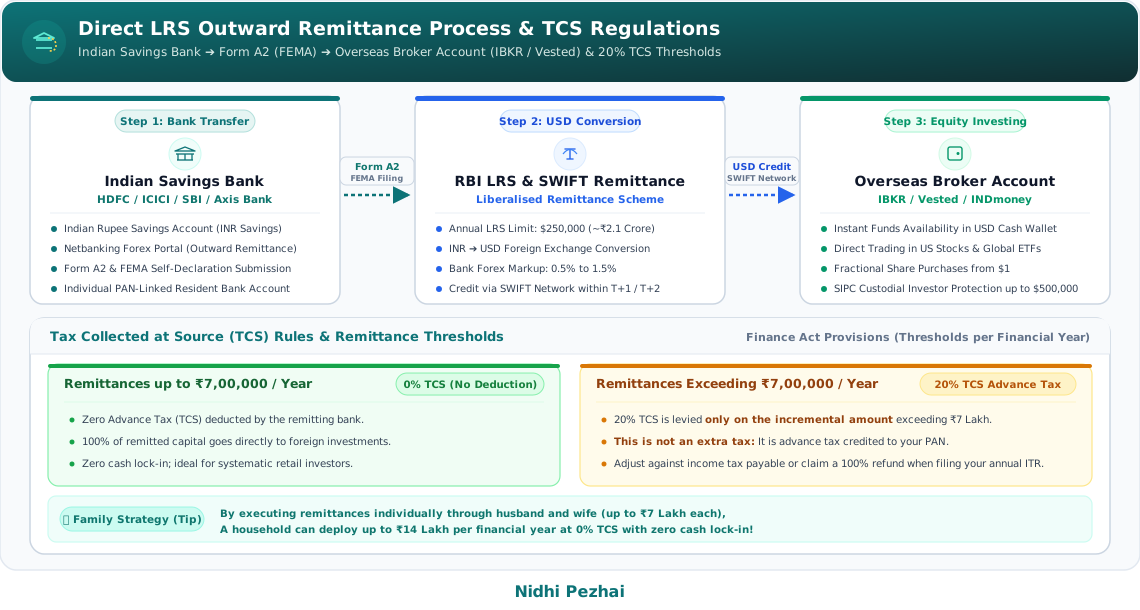
| LRS Remittance Requirement | None (regular mutual fund) | Mandatory (Form A2 / SWIFT) | Mandatory (LRS transfer to IFSC) |
| 20% TCS Applicability | Exempt (0% TCS) | Applies above ₹7 Lakh | Applies above ₹7 Lakh |
| Asset Universe | International fund units only | Direct stocks & global ETFs | ~50 selected US stocks (receipts) |
| Minimum Ticket Size | ₹500 SIP | $10 – $50 (fractional shares allowed) | Price of 1 receipt share |
| US Estate Tax Exposure | Zero (domestic mutual fund units) | Up to 40% tax above $60,000 | Under ongoing regulatory review |
| Ideal For | Beginners & systematic monthly SIPs | Substantial portfolios ($5,000+) | Investors wanting Indian IFSC rails |
Detailed Breakdown of the 3 Routes:
3. Form W-8BEN & The US-India Double Tax Avoidance Agreement (DTAA)
When opening an account with an international broker, the single most critical tax document you execute is Form W-8BEN.
What Is Form W-8BEN?
- It is an official certificate from the US Internal Revenue Service (IRS).
- It formally establishes: "I am not a US citizen or resident alien; I am a tax resident of India."
- Leading digital brokers (IBKR, Vested, INDmoney) automatically populate and file this form electronically during your digital onboarding. The form remains valid for three calendar years.
4. The US Estate Tax: The Hidden $60,000 Trap Every Investor Must Know
This is one of the most critical risks that many financial tutorials overlook.
Under US tax law, the US Estate Tax is levied on the transfer of an individual's assets upon their death. While US citizens enjoy a lifetime estate tax exemption exceeding $13 million, the rules for non-resident aliens (NRAs) are dramatically different:
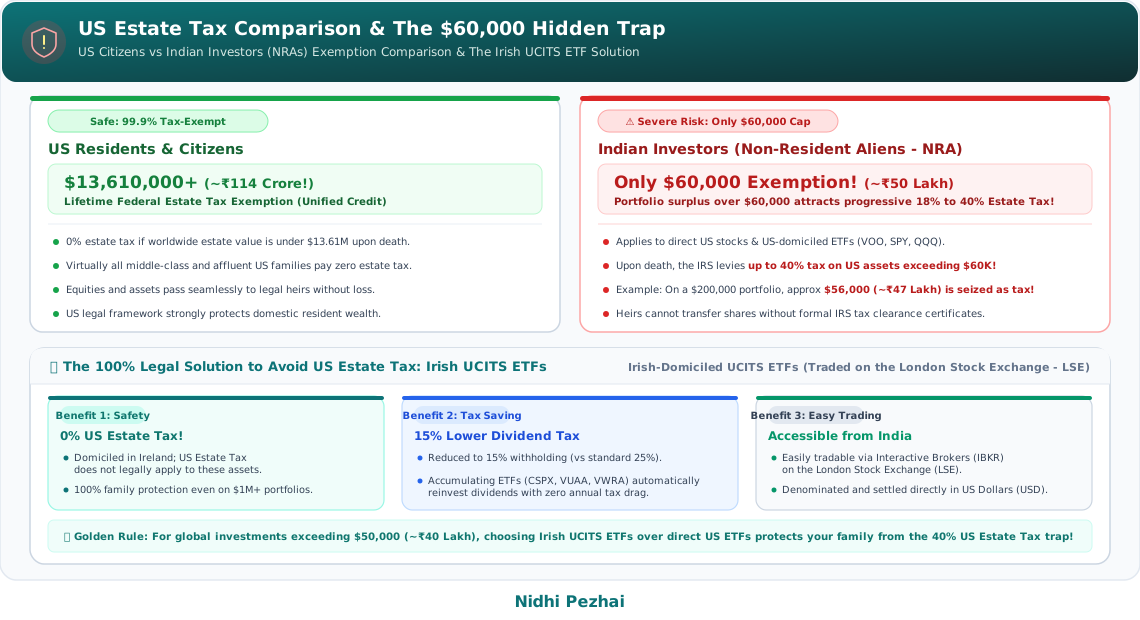
- If an Indian resident holds direct US-sited assets—such as individual shares of Apple, Google, or US-domiciled ETFs like Vanguard S&P 500 (VOO) or SPDR (SPY)—the estate tax exemption limit is only $60,000 (roughly ₹50 Lakh)!
- Any US-sited portfolio value exceeding $60,000 is subject to a progressive US estate tax rate of up to 40% upon the investor's death! The IRS can confiscate up to 40% of the surplus before the remaining portfolio is transferred to legal heirs.
5. International Broker Comparison for Indian Investors
A side-by-side comparison of the leading platforms used by Indian residents for overseas investing:
| Broker & Regulation | Fees & AMC | Irish UCITS ETFs (0% Estate Tax) | Best Suited For |
|---|---|---|---|
|
Interactive Brokers (IBKR)
Direct Global Broker (SEC & FINRA regulated)
Fractional shares supported
|
₹0 AMC (No monthly fees)
Brokerage: ~$0.005/share (min $1)
|
✓ Full Access
Access to LSE (CSPX, VUAA) for 0% Estate Tax
|
Serious & long-term investors ($5,000+) seeking global diversification & Irish ETFs
|
|
Vested Finance
DriveWealth partner (US SIPC insured)
Fractional shares from $1
|
₹0 Basic Plan
Zero commission on direct US stocks
|
✗ No (US Only)
Direct US listings only ($60K estate tax risk)
|
Beginners wanting a clean mobile interface for direct US brand stocks
|
|
INDmoney
DriveWealth (US) integration
Fractional shares supported
|
₹0 Account Opening
Zero brokerage trades
|
✗ No (US Only)
Direct US listings only ($60K estate tax risk)
|
Investors wanting an all-in-one app to track domestic and US portfolios together
|
|
ICICI Direct / HDFC Global
IBKR or DriveWealth white-label reseller
Fractional shares supported
|
Higher AMC & Fees
Elevated transaction & forex markup fees
|
Limited Availability
Varies depending on institutional tie-up
|
Investors prioritizing convenience within their existing 3-in-1 banking relationships
|
SIPC Protection for Investor Funds: Regulated US brokerages (including DriveWealth and Interactive Brokers) are members of the Securities Investor Protection Corporation (SIPC). If a brokerage encounters insolvency, your account securities and cash are legally protected up to $500,000 per investor (with a $250,000 sub-limit for cash).
6. A 5-Step Action Plan to Start Investing in US Equities
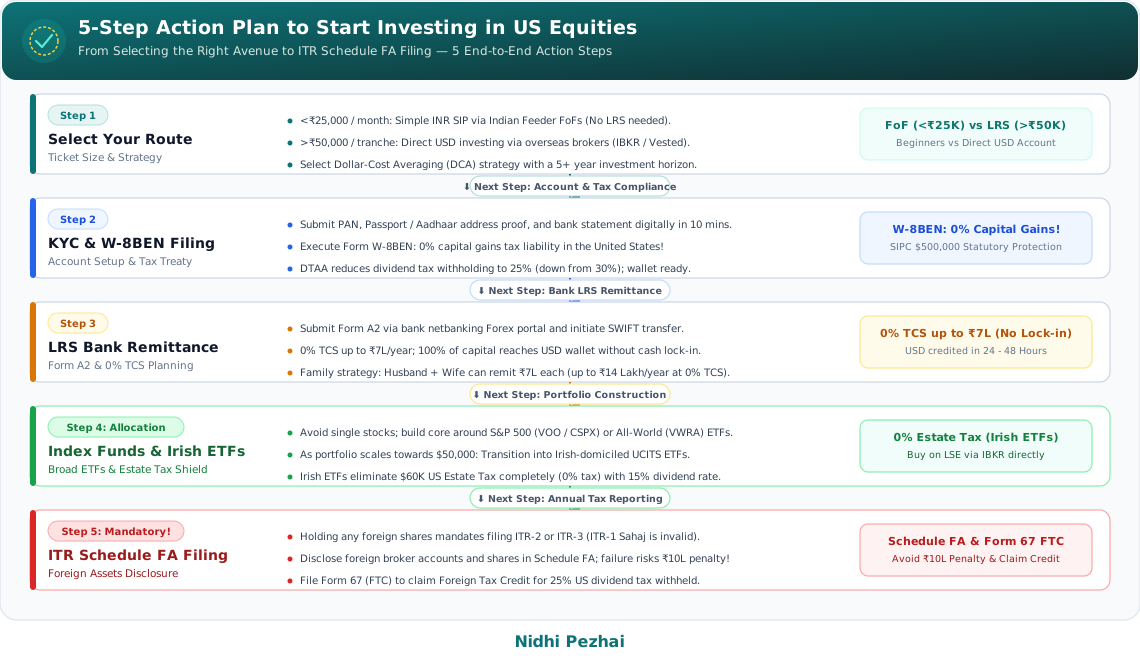
- Step 1: Select Your Route:
- Deploying ₹2,000 to ₹25,000 per month? Start with domestic Indian Feeder Funds (FoF) via regular mutual fund apps.
- Deploying ₹50,000 or more per remittance? Open a direct international brokerage account with IBKR or Vested.
- Step 2: Complete KYC & Form W-8BEN:
- Complete digital paperless onboarding using your PAN, Passport/Aadhaar for address proof, and bank statement.
- Ensure Form W-8BEN is electronically signed to secure 0% US capital gains tax and the reduced 25% dividend withholding tax.
- Step 3: Fund the Account & Plan for TCS:
- Initiate outward remittance through your bank's net banking portal under LRS by submitting Form A2.
- Factor in bank forex markup (typically 0.5% to 1.5%). Keep remittances under ₹7 Lakh per financial year to stay at 0% TCS (or up to ₹14 Lakh combined across spouses).
- Step 4: Build a Broad Market Portfolio & Consider Irish ETFs:
- Rather than stock picking individual speculative names, build your core around low-cost index ETFs tracking the S&P 500 (VOO or CSPX) or an All-World Index (VWRA).
- As your foreign portfolio approaches $50,000, systematically transition new capital into Irish-domiciled UCITS ETFs (CSPX / VUAA) via IBKR to eliminate the 40% US Estate Tax trap.
- Step 5: Maintain Regulatory Compliance & File Schedule FA:
- Obtain annual account statements and transaction summaries from your broker.
- Report all foreign assets, bank balances, and dividends in Schedule FA when filing your Indian Income Tax Return (using ITR-2 or ITR-3).
- File Form 67 prior to filing your ITR to claim Foreign Tax Credit (FTC) for the 25% US dividend tax withheld.
7. Frequently Asked Questions (FAQs)
Related Guides & Calculators
- Domestic equity allocation: Index Funds vs Active Mutual Funds Guide
- Holistic asset allocation strategy: Portfolio Creation Approach
- Long-term compounding growth: Mutual Fund SIP Calculator
- Financial milestones planning: Goal-Based Investing Calculator
Conclusion
The Indian equity market continues to offer compelling domestic expansion opportunities. However, a prudent investor does not confine their financial future within a single geographical border or a single currency.
Beginners can take their first global steps through domestic Indian Feeder Funds, while investors deploying larger sums can open direct international brokerage accounts to build dollar-denominated assets across broad-market indices like the S&P 500.
By adhering to RBI LRS compliance, optimizing the ₹7 Lakh TCS threshold, and reporting accurately in Schedule FA, you can effectively participate as a global shareholder in the world's most innovative enterprises.
Disclaimer: This article is for informational and educational purposes only and does not constitute an investment recommendation or financial advice. International investments carry foreign exchange volatility, market risks, and regulatory cross-border nuances. Consult a Chartered Accountant (CA) or SEBI-registered Investment Advisor (RIA) before committing capital.
Official Resources & Regulatory Links:
- Reserve Bank of India — LRS Scheme FAQs
- RBI Database on Indian Economy (DBIE) — Historical Exchange Rates
- Federal Reserve Bank of St. Louis (FRED) — USD/INR Spot Exchange Rate History
- Income Tax Department of India — TCS & Foreign Assets Reporting
- US Internal Revenue Service (IRS) — Form W-8BEN Instructions
- IFSCA — International Financial Services Centres Authority
- NSE IX — GIFT City International Exchange