
When a bonus, salary increase or monthly surplus leaves you with extra money, should you prepay your home loan or invest in equity mutual funds? There is no single answer. The choice depends on expected returns and risk, but also on liquidity, taxes, your income and peace of mind.
This guide uses a ₹50 lakh home-loan example to explore four approaches, tax considerations and possible hybrid strategies. All calculations are illustrations, not forecasts or personal advice.

1. The core dilemma: debt freedom or wealth building?
With a reducing-balance loan, the interest portion of an EMI is usually higher at the beginning because the outstanding principal is larger. For a ₹50 lakh loan at 8.5% for 20 years, the first monthly payment of approximately ₹43,391 contains:
- Interest: about ₹35,417.
- Principal repayment: about ₹7,974.
If the rate remains at 8.5% and payments follow the original schedule, total repayment is approximately ₹1.04 crore, including ₹54.14 lakh in interest. A floating rate, changes to the EMI or fees will change the result.
Prepayment reduces the outstanding principal and can save future interest. Equity investing offers the possibility of higher long-term returns, but returns fluctuate and can be negative, including over long periods. Past performance is not a guarantee: see NSE Indices' Nifty 50 information and AMFI's data. An index return is not the same as an investor's actual fund return.
Does the loan stage matter?
| Loan stage | What to consider |
|---|---|
| Early years | More payments remain, so an early prepayment can avoid interest over a longer period. Keep adequate liquidity first. |
| Middle years | Compare remaining interest savings, investment horizon, liquidity and risk. A split approach may be appropriate. |
| Final years | Fewer payments remain, so the total interest saved on a prepayment is often lower. Prepayment can still be worthwhile; investing is not automatically better. |
For example, ₹5 lakh invested for five years at a hypothetical 12% compounded annually becomes approximately ₹8.81 lakh before tax and costs. This is not assured and must be compared with the interest saved over the same period, tax effects and the risk of loss. EMI interest proportions vary with the loan terms and rate; do not rely on fixed percentages for every loan.
This comparison highlights factors to consider; returns, tax treatment and interest savings depend on your circumstances:
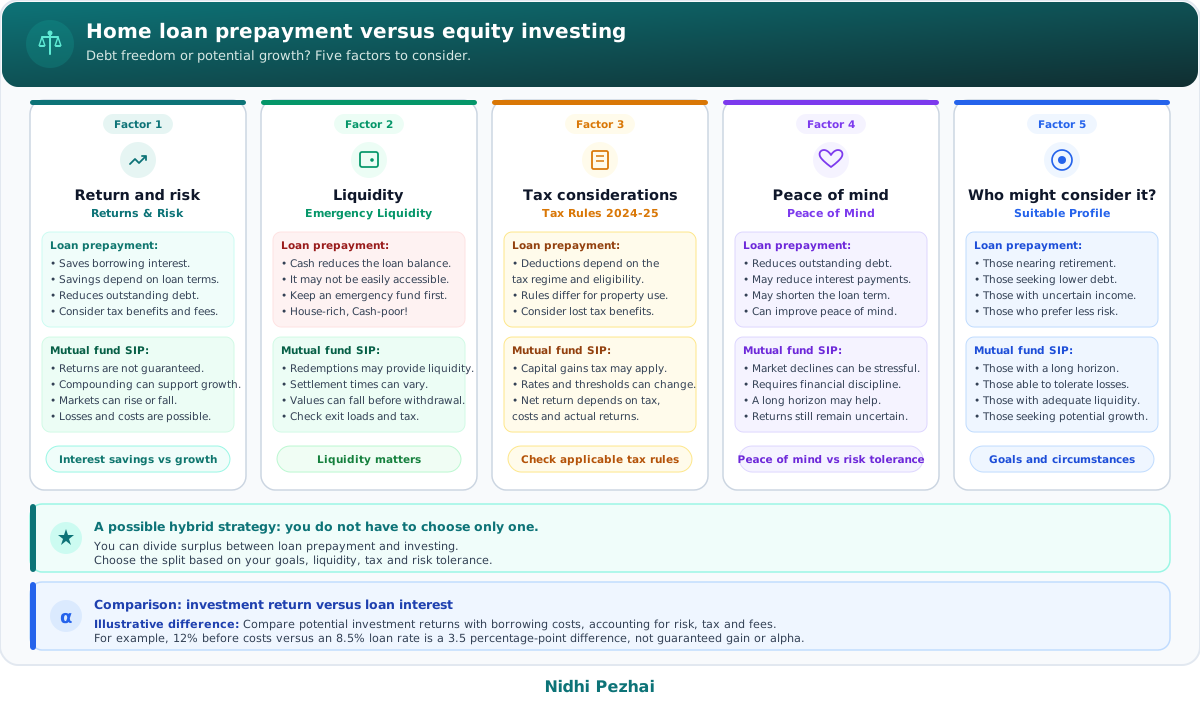
2. Example comparison: a ₹50 lakh loan and four approaches
Assume a ₹50,00,000 loan at 8.5% annually, with a fixed rate for illustration, monthly interest, a 240-month term and an EMI of approximately ₹43,391. Loan calculations use the unrounded EMI, apply extra payments after the regular EMI, and reduce the final payment to the balance due. They exclude fees and tax.
| Approach | Additional contribution | Loan paid off | Total interest | Interest saved against baseline |
|---|---|---|---|---|
| Baseline | None | 240 months | ₹54.14 lakh | — |
| 1. Monthly prepayment | ₹10,000 per month until payoff | 155 months | ₹32.35 lakh | ₹21.79 lakh |
| 2. Equity SIP | ₹10,000 per month invested | 240 months | ₹54.14 lakh | None |
| 3. Extra annual EMI | ₹43,391 after every 12th EMI until payoff | 201 months | ₹43.85 lakh | ₹10.29 lakh |
| 4. Step-up payments | Increase the entire EMI by 5% after each year | 147 months | ₹34.62 lakh | ₹19.52 lakh |
The approaches require different cash flows and timing. This is not a like-for-like final-wealth comparison: it does not invest the EMI and surplus freed after early payoff, nor does it account for investment taxes, costs or changes in rates. To choose, model all available cash flows over the same horizon.
Approach 1: Prepay ₹10,000 each month
Add ₹10,000 to the EMI and keep the regular EMI unchanged. Under these assumptions the loan finishes in about 155 months, saving approximately ₹21.79 lakh in interest. The final extra payment may be smaller than ₹10,000.
The benefit is avoided borrowing interest, not a separately paid, universally risk-free investment return. Actual savings depend on future rates, lender terms, charges, tax benefits and how the payment changes the loan schedule.
Approach 2: Invest ₹10,000 each month
Continue the regular EMI and invest ₹10,000 monthly in an equity fund. With 240 contributions at the beginning of each month and a hypothetical 12% nominal annual return compounded monthly, ₹24 lakh contributed grows to approximately ₹99.91 lakh before taxes and costs. At month 155, the same assumed investment would be worth approximately ₹37.12 lakh.
These are mathematical projections, not guaranteed returns. A 12% nominal rate divided by 12 each month is an assumption and is not the same as a 12% effective annual CAGR. The fund value and remaining loan balance could be very different in reality; selling investments to repay the loan may involve losses or tax. Comparing the fund balance alone with total loan interest would not fairly compare the strategies.
Approach 3: Pay one extra EMI each year
Use an annual bonus or other surplus to pay an additional ₹43,391 toward principal after every twelfth EMI. In this example the loan finishes in 201 months, about 3 years and 3 months early, and saves approximately ₹10.29 lakh in interest. Confirm how the lender applies extra payments and whether any charges apply.
Approach 4: Increase the EMI by 5% each year
Increase the total monthly payment by 5% after each completed year: approximately ₹43,391 in year one, ₹45,561 in year two and ₹47,839 in year three. The model pays off the loan in 147 months and saves approximately ₹19.52 lakh in interest. This requires an increasing budget and lender acceptance.
The original article estimated an 11-year payoff and over ₹27 lakh saved. Those figures do not match the stated assumptions; the amounts above are recalculated.
3. Tax regime and capital gains
Tax treatment can change the comparison. The following is a general overview, not a calculation of your tax liability:
- New tax regime: Interest on a self-occupied home loan is generally not deductible under section 24(b), and the section 80C deduction for principal repayment is generally unavailable. For a let-out property, interest may be deductible against rental income subject to applicable rules and restrictions; losses from house property generally cannot be set off against other income under the new regime.
- Old tax regime: Eligible interest on a self-occupied home loan can be deductible subject to conditions and limits, including a commonly applicable ₹2 lakh limit. Your actual benefit depends on your taxable income, other deductions and whether you can use the deduction. If eligible, a ₹2 lakh deduction at a 30% marginal rate plus 4% cess could save up to ₹62,400 in tax; this is not available to every borrower.
- Equity mutual fund taxation: The original article cites a ₹1.25 lakh annual threshold and 12.5% tax on eligible long-term capital gains above it under Finance Act 2024 rules. The threshold applies across relevant gains, not per investment. Fund classification, holding period, transaction dates, cess and your circumstances matter. Tax is generally assessed on realised gains, not by subtracting 12.5% from each year's return.
Verify current rules with the Income Tax Department or a qualified tax professional before deciding.
4. Liquidity and the “house-rich, cash-poor” problem
Imagine Vinoth uses all his savings and bonuses to repay his home loan, then loses his job and faces an unexpected medical expense. Although he owns his home, he may have insufficient cash for bills and could need expensive borrowing.
- Prepayment ties up money: Extra principal paid to the lender is generally not readily available for withdrawal.
- Investments have their own limits: Open-ended funds may offer redemption, but settlement times and restrictions vary. Equity values can fall when you need the money, so equity funds are not a substitute for a safe emergency reserve.
- Keep an emergency fund: The original article suggests holding 6–12 months of household expenses and EMIs. The appropriate amount and accessible, low-risk location depend on your circumstances.
5. Who might consider each approach?
Consider prepayment
Prepayment may appeal to someone approaching retirement, worried about debt, facing a high loan rate, or wanting to reduce future obligations. Earlier prepayment can save interest over more remaining months. For someone with uncertain income, preserve sufficient emergency cash first: paying down principal does not necessarily reduce the next EMI.
Consider equity investing
Investing may suit someone with a long investment horizon, dependable cash flow, adequate emergency savings and insurance, and the ability to tolerate market declines. A long horizon does not guarantee equity will outperform prepayment. Consider your overall portfolio and goals rather than using age or the loan's remaining term as an automatic rule.
6. A hybrid strategy: 50:50 or 70:30
You need not choose only one path. For example, split a ₹10,000 monthly surplus into ₹5,000 of prepayment and ₹5,000 of equity SIP:
- Under the loan assumptions above, prepayment finishes the loan in about 187 months, saving approximately ₹13.89 lakh in interest.
- If the ₹5,000 SIP continues for 20 years under the same hypothetical 12% nominal annual, monthly-compounded beginning-of-month assumption, it reaches approximately ₹49.96 lakh before tax and costs.
These calculations assume the SIP continues after the loan is repaid and do not assign the freed EMI to another use. The investment outcome is uncertain; a split does not guarantee liquidity or returns.
Another option is a milestone-based split: allocate 70% of the surplus to prepayment and 30% to investing until the principal falls from ₹50 lakh to ₹25 lakh, then reassess the allocation. Neither split is universally optimal.
7. Home-loan overdraft facilities
Some banks offer home-loan overdraft products, such as SBI Maxgain. Depending on the contract, eligible funds parked in a linked account reduce the balance on which loan interest is calculated.
For example, if the outstanding balance is ₹50 lakh and ₹5 lakh is eligible for offset, interest may be calculated on ₹45 lakh. Withdrawing funds increases the interest-bearing balance again. Access, withdrawal limits, interest calculation, tax treatment and availability depend on the product and account terms; do not assume immediate or unrestricted access.
Such loans may carry higher rates or fees than ordinary home loans. Compare the total cost, the balance you expect to maintain and the risk of spending your reserve before choosing one.
8. Six-step decision checklist
- Do you have an accessible emergency fund covering household expenses and EMIs?
- Do you have appropriate term life and health insurance for your family's needs?
- How long is your working and investment horizon, and how stable is your income?
- What is the remaining loan balance, tenure and interest saved by prepayment?
- What are your loan rate, tax benefits, prepayment charges and investment costs?
- Can you tolerate market losses without jeopardising essential goals or payments?
9. Frequently asked questions
1. Do lenders charge for home-loan prepayment?
RBI rules generally prohibit prepayment charges on qualifying floating-rate loans to individuals for non-business purposes, subject to the applicable rules and loan terms. Fixed-rate loans and other arrangements can differ. Check the lender's terms and the rules applicable to your loan.
2. Should I reduce the tenure or the EMI?
Keeping the EMI unchanged and reducing the tenure generally saves more interest than reducing the EMI while retaining the original tenure, assuming the same rate and prepayment. Reducing the EMI can instead improve monthly cash flow. Ask your lender how each option changes your schedule.
3. When does prepayment help most?
For the same prepayment and unchanged loan terms, paying earlier generally avoids interest over more months. Later prepayment can still save interest; neither loan stage alone determines whether investing is preferable.
4. Can interest on a let-out property be deducted under the new regime?
Interest may be deductible against rental income under applicable house-property rules, subject to restrictions. Treatment of losses and other conditions differs from the old regime. Check the current rules for your property.
5. Is a home-loan protection plan necessary?
Consider your family's protection needs and compare a lender's loan protection plan with an appropriate term life policy. Premiums, cover, exclusions and eligibility vary; a separate policy is not automatically cheaper or suitable for everyone.
Related guides and calculators
- Home loan EMI calculator
- Mutual fund SIP calculator
- Emergency fund planner
- Guide to lending products
- How to build an investment portfolio
- Guide to insurance products
Conclusion
Prepayment can reduce future interest and debt-related stress. Investing offers potential growth but involves market risk. A hybrid approach can balance both goals, provided you retain enough liquidity and choose an allocation appropriate to your circumstances.
Disclaimer: This article and its examples are for general financial education, not financial or investment advice. Rates, tax laws and market conditions change. Consult a qualified SEBI-registered investment adviser or chartered accountant before making a major financial decision.