
A credit card can be a useful payment tool when managed carefully: depending on the card's terms, it can offer an interest-free period, cashback, rewards or other benefits. But carrying a balance can lead to high interest and fees that quickly outweigh those benefits.
Why do banks offer rewards? How does revolving interest work? What happens when you pay only the minimum amount due? What costs can remain in a “no-cost EMI”, and how can you make better use of rewards? This guide explores these questions and ways to avoid debt traps.
At a glance
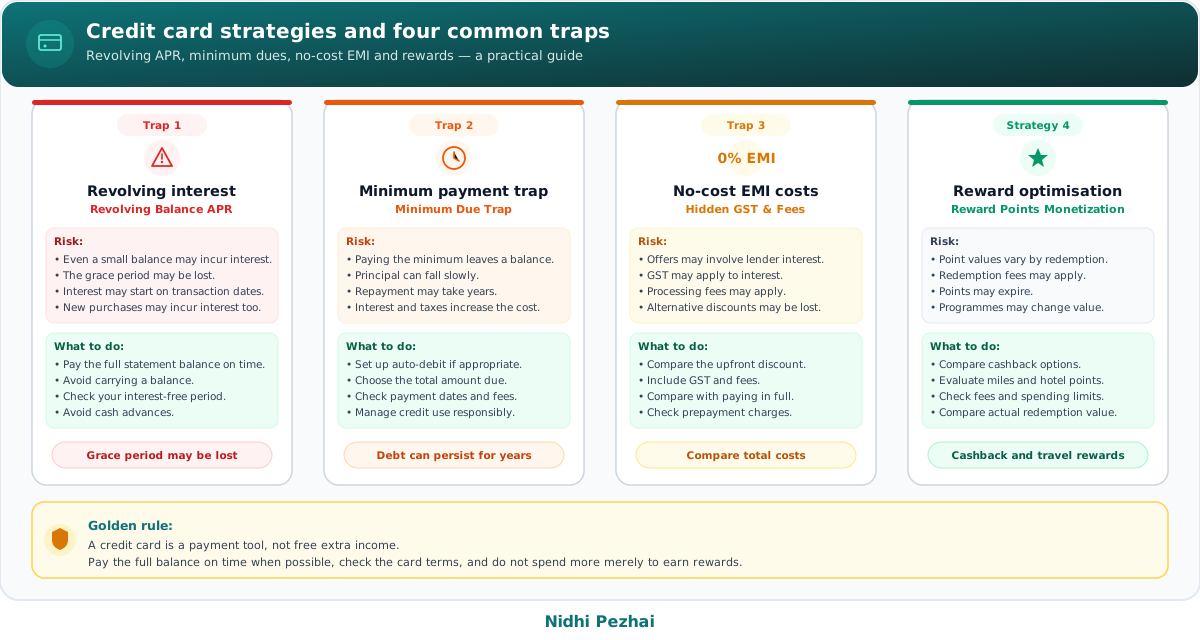
- Revolving interest: The source article illustrates rates of 42% to 49% a year. Rates and the loss of an interest-free period depend on your card's terms.
- Minimum payments: Paying only the minimum can leave most of the principal outstanding and make repayment expensive and prolonged.
- No-cost EMI: Interest discounts may not cover GST, processing fees or a lost alternative discount.
- Rewards: Compare redemption value, fees, expiry dates and spending conditions before choosing a reward.
1. The bank's business model: transactors and revolvers
Cardholders can be grouped broadly into transactors, who pay the full statement balance by the due date, and revolvers, who carry a balance into the next month.
| Aspect | Transactor | Revolver |
|---|---|---|
| Payment | Pays the total amount due on time | Pays less than the full amount, often only the minimum |
| Interest | Usually avoids purchase interest when the terms for the interest-free period are met | May incur interest, fees and applicable tax |
| Rewards | Can benefit from eligible cashback and points | Interest and charges can exceed rewards |
| Credit history | Timely payments can help maintain a healthy record | High utilisation or missed payments can affect credit health |
| Bank revenue | May include merchant-related fees | Can include interest and other charges |
| Outcome | Uses the card as a payment-management tool | Risks an ongoing debt cycle |
Banks may earn merchant fees when a card is used, and interest and fees from revolving balances. Charges vary by issuer and transaction. Aim to be a transactor: pay the full amount due by the due date whenever possible.
2. Revolving APR and the loss of the interest-free period
A monthly interest rate of 3.5% corresponds to a nominal annual rate of 42% (3.5% × 12). A rate of 3.75% a month corresponds to 45% on the same basis. The source article compares these with home and personal loan rates; actual rates and the effective cost depend on the lender, compounding, tax and fees.
Many cards offer an interest-free period on purchases when the full statement balance is paid on time. If it is not, the issuer may withdraw that benefit, charge interest from each transaction date and charge interest on new purchases until outstanding amounts are cleared. The precise conditions vary by card: check its Most Important Terms and Conditions (MITC).
Example: leaving ₹1,000 unpaid
Arun buys a TV for ₹50,000 on 5 May. The statement is dated 20 May, with payment due on 9 June. He pays ₹49,000 on the due date and leaves ₹1,000 outstanding. The following illustrative calculation assumes a 42% annual rate, the loss of the interest-free period and 18% GST on interest:
| Calculation | Amount |
|---|---|
| ₹50,000 × 42% ÷ 365 × 35 days | ₹2,013.70 |
| ₹1,000 × 42% ÷ 365 × 15 days | ₹17.26 |
| Total interest | ₹2,030.96 |
| GST at 18% on interest | ₹365.57 |
| Interest plus GST | ₹2,396.53 |
Interest on later purchases or other applicable charges could increase the bill. This is a simplified example, not a quotation: the actual computation, dates and charges depend on the issuer. Paying the full statement balance on time helps avoid this kind of cost.
3. The minimum-payment spiral
The minimum amount due is the smallest payment specified on the statement. Its calculation differs between issuers; it may include a proportion of the balance, interest and fees. Paying it on time generally helps avoid a late-payment fee, subject to the issuer's terms, but does not eliminate interest on the remaining balance.
Example: ₹5,000 paid on a ₹1,00,000 balance
Assume a 3.5% monthly interest charge and 18% GST on that interest:
| Item | Amount | Share of payment |
|---|---|---|
| Payment | ₹5,000 | 100% |
| Monthly interest | ₹3,500 | 70% |
| GST on interest | ₹630 | 12.6% |
| Principal reduction | ₹870 | 17.4% |
| Principal remaining | ₹99,130 | — |
In this simplified illustration, ₹4,130 of the ₹5,000 payment covers interest and tax, leaving only ₹870 to reduce principal. Actual payment allocation and minimum dues depend on the issuer's terms.
The source article presents an illustration of approximately 222 months (18.5 years) and ₹3,42,800 in total payments for prolonged minimum payments on a ₹1 lakh balance. That outcome depends on the minimum-payment formula, interest, taxes and other assumptions; it is not a universal result. Use the credit-card payoff calculator with your own terms and payment plan.
4. No-cost EMI: GST and other charges
An offer advertised as “0%” or “no-cost EMI” may still have costs. In a subvention arrangement, a merchant discount may offset the lender's interest, while the bank still charges interest on the discounted principal. Read the offer and loan terms; the discount and charges vary.
For example, the source article describes a ₹60,000 phone, an upfront discount of ₹2,624, a financed principal of ₹57,376 and six payments of approximately ₹10,000. Even when the discount offsets the interest, look for:
- GST on interest: An illustration with ₹2,624 of interest and 18% GST adds ₹472.32.
- Processing fee and GST: ₹199 plus 18% GST adds ₹234.82 in this example.
- Lost alternative discount: A ₹4,000 card discount available for a full payment may not apply to the EMI offer.
| Cost | Full payment | No-cost EMI |
|---|---|---|
| Listed price | ₹60,000 | ₹60,000 |
| Alternative instant discount | −₹4,000 | ₹0 |
| GST on interest | ₹0 | ₹472.32 |
| Processing fee including GST | ₹0 | ₹234.82 |
| Total paid | ₹56,000 | ₹60,707.14 |
Under these assumptions the EMI costs ₹4,707.14 more. Check whether each discount is actually available and combinable, and compare the total payable rather than the advertised rate alone.
5. Making use of reward points
Rewards can be redeemed for merchandise, cashback, travel or hotel benefits, but a point does not necessarily have the same value in every option. Compare the price you would otherwise pay with the points and fees required.
The source article gives illustrative redemption values of ₹0.20–₹0.25 per point for some merchandise, ₹1 for some cashback arrangements, and ₹0.80–₹1.50 for some airline or hotel redemptions. These are examples, not guarantees: each programme sets its own conversion rates, caps and eligibility.
- Cashback: Some co-branded cards offer statement credits or partner balances on eligible purchases. The article mentions SBI Cashback, Amazon Pay ICICI and Airtel Axis or Flipkart Axis as examples; current rates, exclusions and caps must be checked with the issuer.
- Travel rewards: Frequent travellers may compare premium-card point transfers to airline or hotel programmes. Transfer ratios, availability, fees and the value of a ticket or stay can vary.
- Expiry: Check when points expire.
- Redemption fees: Factor in any redemption or delivery charge and GST before redeeming.
- Devaluation: Programme rules and conversion rates can change. Avoid assuming that unused points will retain their value.
Do not spend more merely to earn rewards, and compare benefits with annual fees and any interest incurred.
6. Other charges to watch
Cash advances
Withdrawing cash on a credit card can attract a cash-advance fee—for example, 2.5% to 3%, subject to a minimum—and interest may start immediately without a purchase grace period. Check your card's actual charges before withdrawing.
Rent and education payments
Some issuers or payment platforms impose surcharges and GST on rent or education transactions, and may exclude them from rewards. These rules vary by bank, transaction channel and card.
Dynamic currency conversion
When paying a foreign merchant, you may be offered a choice between rupees and the local currency. Dynamic currency conversion can include an unfavourable exchange rate or additional fees. Compare the offered conversion and your card's foreign-transaction charges before choosing; paying in the local currency can avoid the merchant's conversion.
7. Five practical credit-card rules
- Set up full-payment auto-debit: Choose the total amount due rather than the minimum where possible. Keep enough money in the account and verify that the payment succeeds.
- Watch utilisation: For a ₹1 lakh limit, ₹30,000 represents 30% utilisation. Lower utilisation can help credit health, but scoring models and reporting dates vary. Consider paying before the statement date if needed.
- Treat credit as money you must repay: Spend within your budget rather than relying on next month's salary.
- Choose cards for your needs: Compare fuel, grocery, cashback and travel benefits with fees, exclusions and caps; avoid accumulating unnecessary cards.
- Consider the effect of closing an older card: Account age, utilisation, fees and other factors may affect your credit profile. An old no-fee card may be worth keeping if it remains useful, but closure does not automatically produce a particular score change.
8. A plan for getting out of credit-card debt
- Stop new spending: Freeze or temporarily lock the card while you work on repayment.
- Compare repayment alternatives: Ask the issuer about converting the balance to an EMI, or compare a balance transfer, personal loan or secured loan. The source article illustrates EMI rates of 14%–16%, personal loans at 11%–13% and gold loans at 9%–10%; actual offers vary. Compare the full cost, fees, term and collateral risk before borrowing.
- Consider a debt-snowball approach: With several balances, continue required payments on all accounts and put extra money toward the smallest balance first, then move to the next. Alternatively, prioritising the highest interest rate may reduce interest costs.
9. Frequently asked questions
1. Is there a three-day grace period after the due date?
RBI rules prescribe conditions for reporting an account as past due and levying late-payment charges when it remains past due for more than three days. This is not a substitute for paying by the due date or a guarantee that interest will not accrue. Check your issuer's terms and pay early enough for the payment to be credited.
2. Does keeping utilisation at zero guarantee a higher credit score?
No particular score is guaranteed. Credit scores depend on several factors, including payment history, utilisation and credit history. Use credit only as needed and repay on time.
3. Can an annual fee be waived?
Some cards waive annual fees when their spending conditions are met. You can also ask the issuer about a waiver or alternative card, but neither a waiver nor reward points are guaranteed. Check the current terms before spending to reach a threshold.
4. What should I do when closing a card?
Clear outstanding dues, request closure through an accepted channel and retain confirmation or a no-dues certificate. Check your credit report later to confirm the account is reported correctly. Applicable RBI rules specify timelines and conditions for closure.
5. Who is liable for an unauthorised transaction?
Report an unauthorised transaction to the bank immediately. Customer liability depends on the circumstances, reporting time and applicable RBI rules; do not assume every case has the same limit. Follow the bank's reporting process and retain the complaint reference.
Related guides and calculators
- Credit-card payoff calculator
- Credit score and creditworthiness guide
- Personal finance fortification
- Guide to lending products
- Personal finance fortification checklist
Conclusion: discipline brings freedom
A credit card is not extra income; it is a borrowing and payment tool. Paying the full bill on time, understanding charges and avoiding unnecessary spending can help you use it without falling into a revolving-debt trap.
Disclaimer: This article is for financial awareness and consumer education, not an advertisement for any bank or financial product. Credit-card terms, rates and fees can change. Read your card's Most Important Terms and Conditions before using it.